José Martí, a crucial figure in the Cuban independence movement and a celebrated literary icon, owes much of his intellectual and emotional development to the influences he encountered during his formative years. Among these influences, María de Mendive stands out as a crucial mentor and guiding force in Martí’s life.
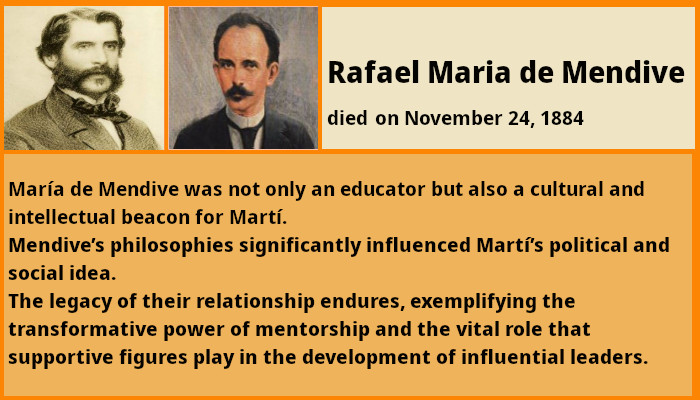
Mendive died on November 24, 1884, leaving a profound legacy, as Martí’s teacher and a key figure in his upbringing, The teacher’s impact on Martí was profound, shaping not only his educational trajectory but also his moral values and revolutionary ideas. Mendive was not only an educator but also a cultural and intellectual beacon for Martí. He served as Martí’s teacher from a young age, nurturing his burgeoning talent in literature and instilling in him a deep appreciation for the arts.
Mendive recognized Martí’s potential and encouraged his writing, providing him with the right environment to flourish creatively. His dedication to education and her progressive ideals challenged the conventional norms of the time, allowing Martí to explore new thoughts and perspectives beyond the rigid confines of traditional education.
Mendive’s teaching was characterized by his emphasis on critical thinking and moral integrity, values that deeply resonated with Martí. He introduced him to classic literature, philosophy, and history, which expanded his worldview and fueled his desire for social justice. By cultivating a space where Martí could express his ideas freely, she played an integral role in shaping his intellectual development.
Mendive’s philosophies significantly influenced Martí’s political and social ideas. He held strong beliefs in social justice, equality, and the innate rights of individuals, principles that would later become central to Martí’s own revolutionary thoughts. His early writings often reflect Mendive’s focus on the importance of liberty and human dignity, themes that would permeate his later works and speeches advocating for Cuba’s independence from Spanish rule.
Moreover, Mendive was an advocate for education, particularly for women, and this inspired Martí’s commitment to fight for the rights of all oppressed people. He absorbed her ideals of equality and justice, which inspired his vision of a free Cuba where all citizens could enjoy equal rights irrespective of their gender, race, or social class. This vision would later manifest in Martí’s foundational role in the Cuban Revolutionary Party and his later writings, where he emphasized unity and collective action against tyrannies.
The relationship between Martí and Mendive extended beyond the academic sphere; it was also deeply emotional. Martí held Mendive in high regard, viewing him not only as a mentor but also as a paternal figure. This bond provided him with the emotional support necessary to navigate the challenges he faced during his early life, including political persecution and exile. Mendive’s nurturing personality offered Martí a sense of stability and encouragement, which fortified his resilience.
Her belief in his potential and his unwavering support during his turbulent youth likely reinforced his determination to become a national figure who would fight for justice and liberation. This personal connection also reflects the broader theme of mentorship that is often critical in the development of influential leaders.
Rafael María de Mendive’s influence played a crucial role in shaping Martí into a leading voice for freedom, social justice, and human dignity. His progressive ideals and nurturing demeanor fostered his intellectual growth and instilled in him a lifelong commitment to the principles of equality and justice. The legacy of their relationship endures, exemplifying the transformative power of mentorship and the vital role that supportive figures play in the development of influential leaders.