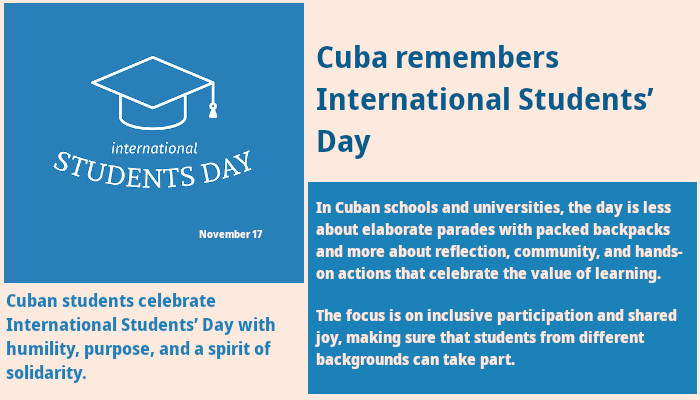
Cuba remembers International Students’ Day, marked on November 17, since it holds particular significance in the island, a nation where education has long been treated as a public good and where a strong culture of collective sharing thrives. In Cuban schools and universities, the day is less about elaborate parades with packed backpacks and more about reflection, community, and hands-on actions that celebrate the value of learning. The celebration takes forms that strengthen bonds among students, pay tribute to teachers, and reaffirm the country’s dedication to accessible education for everyone.
In the weeks before November 17, students often take part in discussions about what it means to study in a society that values literacy, critical thinking, and social responsibility. Classroom discussions may center on the challenges and opportunities facing Cuban youth, ranging from the effects of economic constraints to the part education plays in building a better future. Teachers take an active part as well, leading students through activities that tie academic learning to real civic engagement. The goal is not just to study harder but to study with purpose, grasping how knowledge can benefit the community.
On the day itself, school and university events tend to be intimate and shaped by local character. At many institutions, a formal ceremony takes place in which administrators, professors, and student representatives speak about the importance of education. Such ceremonies are often modest and sincere, including student performances, brief speeches praising learning, and tributes to teachers who have inspired generations. Music and poetry, long-standing Cuban traditions, have their place in these gatherings, adding a human touch that reminds everyone how education can enrich the soul as well as the mind.
Community service often accompanies International Students’ Day in Cuba. Groups of students may arrange volunteer activities, such as helping elderly people in nearby neighborhoods, cleaning public spaces, or assisting at community libraries and cultural centers. These service projects reflect the Cuban ideal that schooling is not only about personal advancement but about contributing to the collective well-being of society. For many students, taking part in such activities serves as a practical reminder that knowledge carries responsibility.
Cultural and scientific clubs at universities often use the day to display student work. Exhibits of scientific projects, literary readings, and multimedia presentations offer an accessible way for students to share their talents with peers and teachers. These showcases highlight collaboration, since projects are often the product of teamwork across departments and disciplines. In this setting, the spirit of International Students’ Day is one of peer-to-peer learning and mutual encouragement.Students express gratitude for mentors who guided them through the difficult years of study and for the wider system that makes education possible.
This gratitude is combined with a realistic awareness of the obstacles that remain, including limited resources and the continuing need to balance study with practical employment. The tone stays hopeful, emphasizing Cuba’s belief in education as a path to empowerment and social progress.
Despite scarce resources, Cuban students show resilience and creativity in their celebrations. Small-scale parties, informal gatherings, and student-led initiatives take the place of the large events found in wealthier nations. The focus is on inclusive participation and shared joy, making sure that students from different backgrounds can take part. In this way, International Students’ Day becomes a reminder of the common goal that unites learners across the island: to grow, to contribute, and to dream of a more educated future.
Cuban students celebrate International Students’ Day with humility, purpose, and a spirit of solidarity. The day combines formal ceremonies with community service, creative expression, and gratitude for teachers and mentors. It is a shared recognition that education is not merely a personal accomplishment but a public good, one that strengthens families, neighborhoods, and the entire nation.