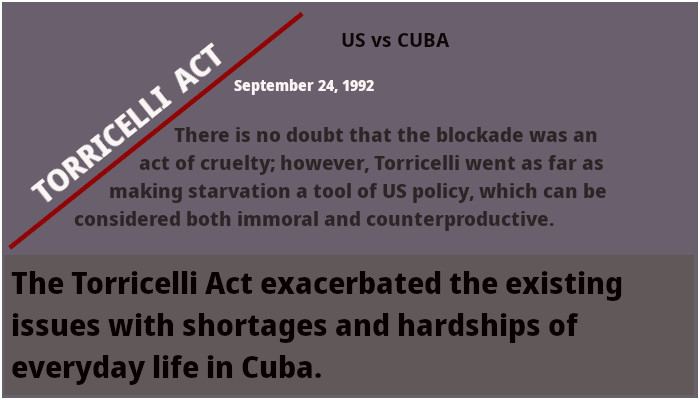
The Torricelli Act passed by the US Congress on September 24, 1992, and amended the blockade imposed on Cuba back in 1962. Proponents of this act claimed it would help increase pressure on the Cuban government. However, it affected various aspects of Cuban society in more significant ways than intended.
The Torricelli Act increased the pressure on the Cuban population. The blockade that was imposed on Cuba prevented the citizens from purchasing American products, which severely limited the range of available goods and contributed to widespread shortages in the country. Although the Cuban government continued to provide free education and healthcare, these were offset by the inability of the population to afford food and other essential goods.
Furthermore, tightening the screws on the Cuban economy meant that the government could invest less in public services. The Torricelli Act exacerbated the existing issues with shortages and hardships of everyday life in Cuba. There is no doubt that the blockade was an act of cruelty; however, Torricelli went as far as making starvation a tool of US policy, which can be considered both immoral and counterproductive.
The act also impacted political and diplomatic relations between the nations. The uncompromising position of the US threatened to undermine regional stability. In effect, not only was the Cuban government unable to develop free markets, but the very idea of them was perceived as a threat by the US government. As a result, not only did the blockade fail to accomplish its goals, but it also led to strained diplomatic relations and a climate of mutual mistrust.
Moreover, Cuba’s neighbors were placed in an ethically challenging position: follow the example of the blockade or continue engaging with Cuba. In reality, there was little incentive for the former, but significant risks for the latter. However, the image of America as a force for good around the world was dealt a severe blow as the US appeared to be unreasonable and uncompromising in its stance towards Cuba. This comes at the cost of losing public support for promoting democracy and reforms in Cuba, as well as the ability to genuinely care about the Cuban people and their welfare.
Lastly, the act harmed private businesses there. The blockade prevented companies and entrepreneurs from engaging with the Cuban market. Therefore, the potential for expansion for many businesses was limited. Additionally, there were fewer incentives for innovation or investment in the local economy, which further stifled business development. As a result, there was a smaller contribution to national wealth and disposable income for many Cubans, which limited day-to-day spending. The overall atmosphere of economic stagnation, caused by blockade-related factors, was a indirect result of the Torricelli Act.
When considering the adverse effects of the Torricelli Act, one must remember that the entire system of sanctions and blockades takes a toll on the affected population. While these acts are designed to impact the ruling government, it is the everyday citizen who suffers first and most severely. Moreover, the US not only fails to achieve its goals, but it makes itself look even worse in the eyes of the public.
The perception of America as a force for good is diminished with every oppressive act of the government towards other nations. Therefore, the negative impact of the Torricelli act on the Cuban people serves as a lesson that blockades and sanctions are rarely useful in international affairs.