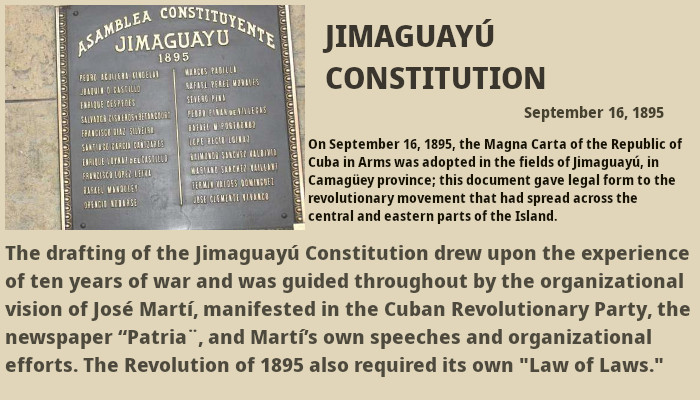
September 16, 1895 marks a very significant moment in Cuban history: the signing of the Jimaguayú Constitution. This event occurred during a turbulent chapter as Cuba fought for independence from Spanish rule, and it underscored both the hopes and the tensions that defined the struggle.
The Jimaguayú Constitution emerged from the broader context of the Cuban War of Independence, which began in 1895 after decades of resistance. The island’s leaders sought a formal framework to govern a future, free Cuba, one that would unite diverse regional voices while preserving principles that many believed could withstand the test of power, both foreign and domestic. The name Jimaguayú itself is tied to the town of Jimaguayú in Camagüey Province, where a provisional political arrangement took shape as revolutionary forces reorganized and prepared for the next phase of conflict and governance.
This constitution reflected the revolutionary mood of the time. It aimed to establish a provisional government that could function as a bridge between immediate military action and a lasting political order. It emphasized notions of national autonomy, civic rights, and the creation of a political structure capable of uniting the island’s disparate factions under a common cause. In a sense, it attempted to translate the fervor of the battlefield into the rules of a state, setting expectations for leadership, justice, and civic responsibility.
Yet, the Jimaguayú Constitution was forged in a landscape of urgency and compromise. The realities of an ongoing war meant that the document needed to be adaptable, pragmatic, and responsive to evolving circumstances. This flexibility was both a strength and a source of tension. For some, the constitution represented a steadfast commitment to a modern, republican future for Cuba. For others, it highlighted the delicate balance between regional autonomy and centralized authority, a balance that would continue to define Cuban politics in the years to come.
The signing on September 16, 1895 did more than mark a legal milestone; it symbolized a collective resolve. It signaled a willingness among Cuban leaders to formalize their visions of self-rule and to set a course that would outlive the immediate conflict. The document served as a beacon for supporters of independence, offering a roadmap for governance that could sustain national mobilization and foster unity among the island’s diverse communities.
In analyzing the legacy of the Jimaguayú Constitution, historians note its dual impact. On one hand, it demonstrated Cuba’s enduring aspiration to create a constitutional framework that could support a republic founded on liberty and justice. On the other hand, the realities of exile, conflict, and the eventual reorganization of Cuban leadership after the war revealed the fragility of early constitutional experiments. Nevertheless, the signing remains a testament to the ingenuity and determination of Cuban leaders who sought to translate the dream of independence into a tangible political structure.
Today, the memory of September 16, 1895 invites reflection on how nations negotiate the transition from war to governance. It reminds us that constitutions are not mere texts; they are living instruments forged in moments of crisis, capable of guiding a people through uncertainty toward a more hopeful future. The Jimaguayú Constitution stands as a historic milestone that captures the spirit of a generation committed to liberty, sovereignty, and the pursuit of a just and orderly society.