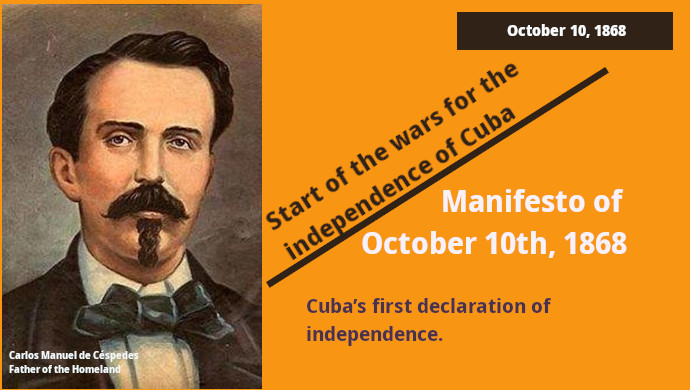
The armed uprising of October 10, 1868 in Cuba, led by Carlos Manuel de Céspedes, marked the beginning of the struggle for independence against Spanish colonialism.Unlike other instances in world history, the “largest of the Antilles” possessed well-defined objective and subjective conditions for such an endeavor.
The event had originally been planned for October 14 of that same year; however, Carlos Manuel de Céspedes, revered as the “Father of the Homeland”, was betrayed. Facing the imminent risk of arrest by the authorities, he decided to move the uprising forward.
That morning, at the La Demajagua sugar mill, located 13 kilometers from the city of Manzanillo, in the eastern part of the island, Céspedes appeared carrying a flag, a symbol of the insurrection. With an impassioned address, filled with both love and a spirit of rebellion, he informed his slaves that they were, from that moment on, free men, and urged them to join the fight for Cuba’s freedom.
It was there that the Manifesto of the Revolutionary Junta, known as the “Manifesto of October 10th”, was read; it became Cuba’s first declaration of independence. This was no act of madness; during that period, the 1850s and 1860s, the capitalist world was being shaken by a profound economic crisis.
Furthermore, the echoes of the American Civil War (1861–1865) reached the Caribbean island. In the view of several historians, that conflict served, in a sense, as a lesson in abolitionism. In Spain, the so-called Glorious Revolution of September 1868 marked a growing estrangement between the metropolis and its colonies, as anti-Spanish sentiment intensified across the Americas, fueled by Madrid’s interventions in Mexico, Santo Domingo, Peru, and Chile.
At that time, the Spanish Crown imposed 76 different types of taxes that stifled the Cuban people, while simultaneously maintaining strict commercial control over the Caribbean island. The Cuban economy was in crisis; although there were some gains within the sugar industry, other sectors remained stagnant. Furthermore, tax funds were being misappropriated, and deep-seated contradictions, manifesting in various ways, had emerged between the western and eastern regions of the island.
Moreover, Cubans were denied political rights and barred from holding positions within the colonial government, which was, at the time, tyrannical, repressive, and militaristic. Socially, enslaved people, peasants, small-scale producers, free Black and mulatto individuals, and other groups faced a “double exploitation”, at the hands of both Spanish officials and criollo (local-born) landowners.
Consequently, the objective conditions for the outbreak of war had matured, a reality underscored by the fundamental conflict between the colony and the metropolis. On a subjective level, many Cubans, who often gathered in Masonic lodges, the only legal venue available to criollos for assembly, recognized the necessity of challenging the Spanish yoke. This led to the formation of a clandestine movement, composed of all those committed to achieving Cuba’s independence.
Prominent figures within this movement included Carlos Manuel de Céspedes, Francisco Vicente Aguilera, Perucho Figueredo, Ignacio Agramonte, Salvador Cisneros Betancourt, Vicente García, Antonio Lorda, Eduardo Machado, and Miguel Gerónimo Gutiérrez, among others. Although these individuals possessed economic means, they were politically disenfranchised; lacking any rights, they came to view war as the only viable path forward. From this, it is clear that they were not motivated by economic factors, but rather by patriotic consciousness.
These figures were the so-called “radical landowners,” who initiated the struggle through a clandestine movement, reaching various agreements during meetings held at locations such as San Miguel de Rompe and the El Rosario sugar mill, among others. Although they agreed on starting the war, some wanted it to begin immediately, while others preferred to wait until the sugar harvest had concluded.
The onset of the war for independence was accompanied by the Revolution’s platform, known as the Manifesto of October 10th. This document served as a guide for the emancipation process and stood as Cuba’s first declaration of independence. In this text, Céspedes outlined the economic, political, and social causes that fueled the struggle for independence, as well as the objectives of the endeavor: the independence of Cuba and the abolition of slavery.
The document asserted that the nation for which they were fighting would guarantee full rights and freedom of speech for its citizens, and that it would maintain free-trade relations with all countries.It also emphasized that Cubans had the right to elect their own leaders; in short, the document captured the aspirations of the Cuban people and the fundamental principles of their struggle. Regarding the issue of slavery, the manifesto did not propose an immediate solution; instead, it called for a gradual abolition, with compensation, specifically to avoid a sudden, disruptive impact on existing wealth.