On September 29, 1878, the colonial Spanish government marked a new chapter in its long struggle with Cuban aspirations by once again exiling the island’s most steadfast voice of independence: José Martí. This act, though aimed at silencing a single man, reverberated through Cuban society and set in motion a sequence of events that would shape the island’s quest for freedom for decades to come.
Martí’s life up to this point had already been a study in resilience and political wit. A man of letters, he used poetry, journalism, and essays to articulate a vision of a free Cuba founded on liberty, justice, and national dignity. His writings crossed borders, inspiring fellow Cubans and drawing attention from supporters across the Caribbean and beyond. Yet his persistent advocacy for independence, coupled with his critiques of colonial governance, often put him at odds with the authorities in Madrid.
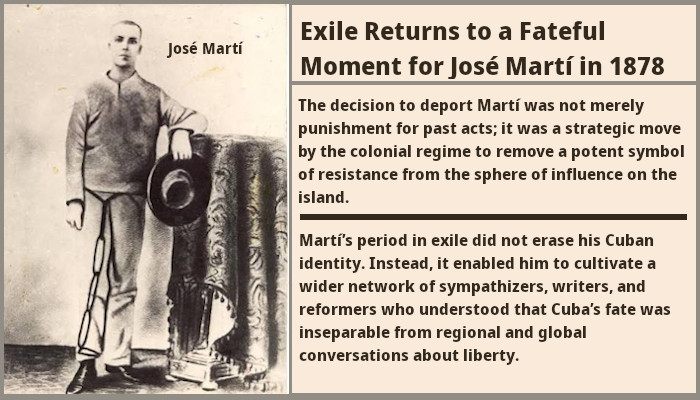
The decision to deport Martí was not merely punishment for past acts; it was a strategic move by the colonial regime to remove a potent symbol of resistance from the sphere of influence on the island. Exile, a familiar tool in the imperial repertoire, carried with it the double-edged aim of neutralizing a threat at home while preserving the illusion of order. For Martí, exile would become a crucible that sharpened his resolve and broadened his horizon. Far from silencing him, it forced him to rewire his approach, to connect the Cuban struggle to broader currents of freedom in the Americas and beyond.
Martí’s period in exile did not erase his Cuban identity. Instead, it enabled him to cultivate a wider network of sympathizers, writers, and reformers who understood that Cuba’s fate was inseparable from regional and global conversations about liberty. He translated his personal trials into a collective cause, using every available platform to sound the call for independence. In letters, essays, and early journalistic dispatches, Martí wove a narrative of national self-determination that would later inform his most famous declarations.
The significance of the 1878 exile lies not only in the immediate political consequences but in its enduring legacy. It underscored the persistence of Cuban national consciousness and demonstrated how a single figure, dedicated and principled, could keep the flame of resistance alive even when barred from home soil. Martí’s experience of deportation highlighted the tension between imperial authority and the human spirit’s longing for self-rule—a tension that would eventually culminate in a broader struggle that finally bore fruit in the late 19th century.
As historians look back on September 29, 1878, they see more than a routine administrative action. They see a turning point that tested both the mettle of a man and the resilience of a movement. Martí’s exile became a chapter in a larger story—one that chronicles how Cubans, inspired by their language, culture, and shared hopes, refused to accept a future defined by foreign domination. It is a reminder that, sometimes, removal from a place of power can intensify the desire for freedom and clarify the path toward national sovereignty.