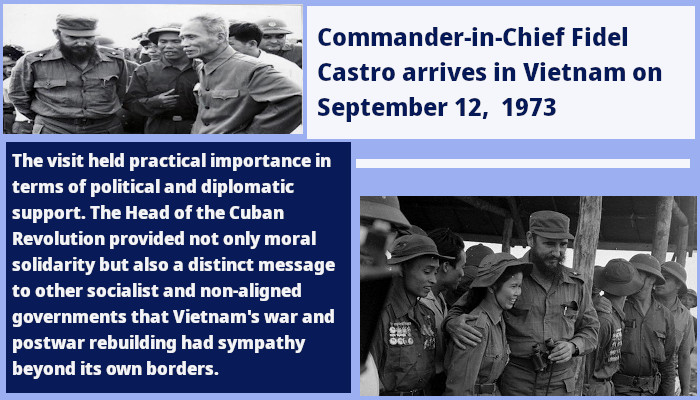
Commander-in-Chief Fidel Castro arrives in Vietnam on September 12, 1973, showing both the lasting solidarity between revolutionary movements and the concrete connections that keep them going. This trip represents a key turning point in Cold War history, since it occurs as the United States was pulling out of direct combat in Indochina and Vietnam. This journey also showcased a common ethos among anti-imperialist struggles and provided a compelling story of internationalist friendship.
Fidel Castro’s visit emphasized a profound philosophical bond between Cuba’s socialist project and Vietnam’s lengthy revolutionary path. Both countries had confronted intense external pressure, withstood embargoes and isolation, yet still pressed forward with a determined faith in sovereignty, dignity, and social justice.
The Cuban President’s presence strengthened the notion that socialist nations were not alone; they depended on mutual assistance and ideological fellowship to face global power dynamics. The visit gave Vietnamese leaders the impression that their struggle belonged to a wider global movement rather than being a regional exception, boosting morale at a time when exhaustion could emerge after years of intense conflict.
The visit held practical importance in terms of political and diplomatic support. Head of the Cuban Revolution provided not only moral solidarity but also a distinct message to other socialist and non-aligned governments that Vietnam’s war and postwar rebuilding had sympathy beyond its own borders. Such international visibility assisted Vietnam in navigating a complicated regional and international landscape, where allies and possible allies could be rallied to offset pressure from major powers. The exchange also created avenues for economic and cultural connections, which could lead to tangible aid, technology transfer, and the sharing of ideas on governance, health, education, and social policy.
The 1973 visit took place at a time of reassessment for many global actors. The Paris Peace Accords had been signed in 1973, and the war’s immediate phase was concluding for the United States and its allies, even as the Vietnamese struggle for reunification persisted. Fidel Castro’s trip mirrored a wider rethinking among revolutionary states about how to present themselves on the world stage: they could show resilience, provide practical support, and maintain anti-imperialist solidarity even as the geopolitical landscape changed. In this regard, Castro’s visit helped shape the narrative of a multipolar world in which non-Western states could affect outcomes and serve as a counterweight to dominant powers.
Finally, the visit’s significance rests in its lasting symbolic value. It reinforced the notion that solidarity across oceans was not just rhetoric but a lived commitment. Through talks, exchanges, and visible gestures of friendship, the trip embodied an ethic of mutual aid that would inspire later generations of activists, students, and policymakers.
For Vietnam, the visit added a layer of international legitimacy to its postwar path, while for Cuba, it showed the country’s willingness to play a global role beyond its Caribbean region.In sum, Fidel Castro’s 1973 visit to Vietnam was more than a diplomatic footnote. It crystallized the unity of anti-imperialist currents, strengthened practical support for a nation rebuilding after war, and enriched global discourse on sovereignty, solidarity, and the possibility of a world where small and large nations alike could shape their own destinies.