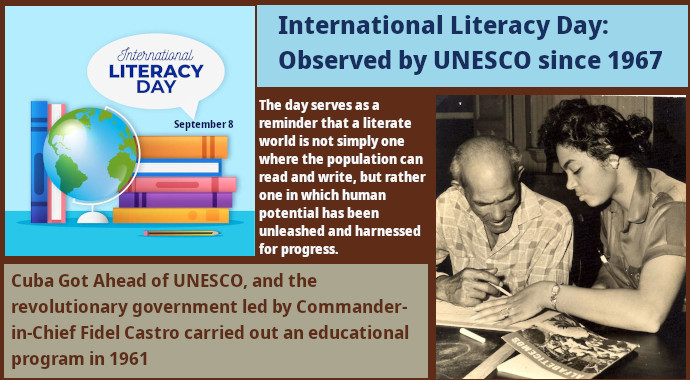
Today education all over the planet celebrates the International Literacy Day: Observed by UNESCO since 1967. The day serves as a reminder that a literate world is not simply one where the population can read and write, but rather one in which human potential has been unleashed and harnessed for progress.
Fortunately, Cuba Got Ahead of UNESCO, and the revolutionary government led by Commander-in-Chief Fidel Castro carried out an educational program in 1961, which became a massive social mobilization that blurred the lines between schooling, political activism, and military precision.
The Cuban Literacy Campaign (1961) remains one of the most storied pedagogical experiments of the 20th century, transforming the country’s social fabric and providing a blueprint for grassroots education worldwide.
Following the 1959 Revolution, the new government identified illiteracy as a primary shackle of the working class. At the time, roughly 23% of the population, concentrated heavily in the rural area, could not read or write. For the revolutionary government, literacy was not just about reading books; it was about “consciousness.” To be literate was to be an active participant in the state’s new ideological direction.
In a daring move, thousands of students from urban secondary schools and universities were recruited into “brigadistas”. These teenagers and young adults were uprooted from their city lives and deployed into the deepest reaches of the Cuban countryside.
Brigadistas lived in the homes of the peasants they taught. They slept in hammocks, ate rural diets, and worked the fields alongside their students during the day, teaching them to read by candlelight at night. The general goal was to bridge the vast cultural and economic chasm between the urban elite and the rural poor.
The campaign did not use standard textbooks. Instead, it employed “functional literacy.” The curriculum was designed to be immediately applicable to the students’ lives. Lessons revolved around agriculture, hygiene, and revolutionary politics. By teaching a farmer to read using a seed catalog or a political manifesto, the state ensured that the act of learning was inextricably linked to the goals of the government.
By the end of 1961, the government declared victory. The official literacy rate jumped to nearly 96%, and Cuba was proclaimed “the territory free of illiteracy.”
The 1961 campaign left a permanent mark on Cuba. It created a generation of urban youth who had seen the poverty of the countryside firsthand, and a rural population that felt, for the first time, integrated into the national identity.
Today, Cuba continues to maintain one of the highest literacy rates in Latin America, a legacy rooted in that singular, feverish year of 1961. The campaign proved that rapid, mass-scale literacy is possible when a state treats education not as a service, but as a national emergency.