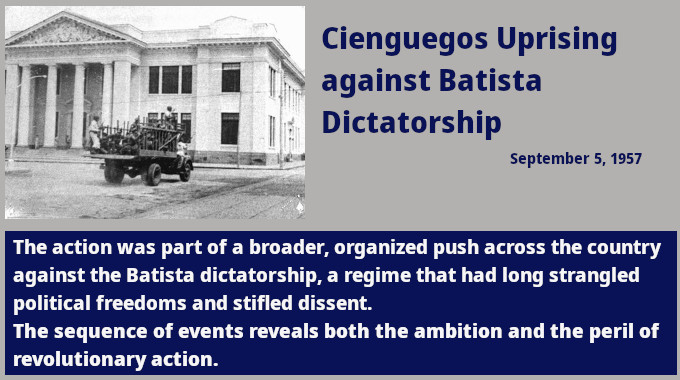
On a day in 1957, a coordinated effort unfolded that would echo through a nation’s memory. In collaboration with the July-26 Movement, naval officers in Cienfuegos city, directed their units to engage in what they described as a rebellion. The action was part of a broader, organized push across the country against the Batista dictatorship, a regime that had long strangled political freedoms and stifled dissent. What began as a strategic move by a faction within the armed forces quickly became a symbol of collective resistance, drawing in workers from the city who took to the streets in solidarity.
The sequence of events reveals both the ambition and the peril of revolutionary action. The Plan, ostensibly a seizure of momentum, relied on the element of surprise and the tapping of national support to destabilize a government long entrenched in power. Yet the reality on the ground proved harsher and more brutal. The rebellion was crushed with relative speed, and 39 revolutionary fighters were killed by Batista forces. The death toll, while numerically precise, carries a weight beyond the numbers: each name represents a life given in pursuit of liberty, each loss a fracture in families and communities that had hoped for change.
Despite the swift suppression, the episode underscores a consistent thread in revolutionary history, the power of collective action. The involvement of city workers highlights how anti-dictatorial movements gain strength not only from military or elite-backed plans but from the ordinary people who endure daily hardship under authoritarian rule. When workers join a cause, strikes, demonstrations, and workplace actions amplify the pressure on regimes that depend on the acquiescence of the labor force to sustain control. In this sense, the events of that day illuminate a broader truth: social cohesion and solidarity can propel political change, even in moments when formal institutions are tightly controlled.
The deed also invites reflection on the costs and ethics of rebellion. The swift quelling of the uprising demonstrates the lengths to which a regime will go to preserve power, utilizing force to deter future challenges. For supporters of the movement, the price paid by the fallen fighters and their families becomes a rallying cry, a reminder of the sacrifices demanded by the pursuit of freedom. For opponents, the same events reveal the risks inherent in challenging an entrenched system, including the brutality that often accompanies political response.
History often records such moments as turning points, not solely because they achieve immediate political change, but because they crystallize a national conscience. They force a society to confront the limits of tolerance, the responsibilities of leadership, and the resilience of its people. The 1957 episode, with its blend of military maneuver, civilian participation, and deadly consequences, serves as a stark illustration of how a struggle for justice can unfold in stages, one day of action, followed by years of resistance, memory, and eventually, transformation.
In looking back, one can draw several lessons. First, popular participation matters: when workers and citizens organize, they alter the balance of power and widen the space for political possibility. Second, the pursuit of liberty often incurs a heavy price, reminding communities to honor those who sacrifice themselves in the name of a greater good. Third, the significance of such events rests not only in the immediate outcomes but in their enduring impact on national identity and collective memory. The day’s narrative remains a touchstone for generations who seek a more just and free society.