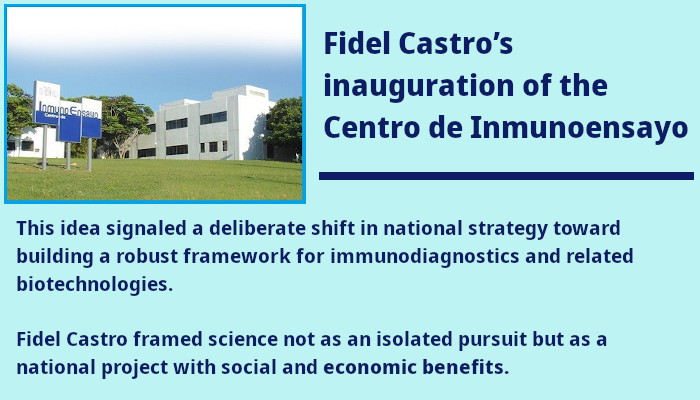
On September 9, 1987, Fidel Castro’s inauguration of the Centro de Inmunoensayo marked a significant moment for Cuba’s scientific, industrial and technological landscape. The event carried more than ceremonial weight; it signaled a deliberate shift in national strategy toward building a robust framework for immunodiagnostics and related biotechnologies.
By spotlighting the center as a nucleus for a cluster of research institutions, the Head of the Cuban Revolution presented a vision of synergy, where academia, public health, and industry collaborate to advance pharmaceutical capabilities and scientific knowledge.
The centerpiece, the Centro de Inmunoensayo (Immunoassay Center), embodies the logic of modern science: create specialized facilities that can produce reliable diagnostic tools while serving as anchors for broader research programs. Immunoassays, which detect the presence or amount of specific substances in a sample, are foundational to healthcare, agriculture, and environmental monitoring.
Establishing a dedicated center for this field implies a commitment to improving disease surveillance, patient care, and the efficiency of pharmaceutical development. It also reflects an understanding that breakthroughs in diagnostics can accelerate drug discovery and, in turn, bolster the country’s self-sufficiency in healthcare.
Fidel Castro’s plan extended beyond a single building to a networked approach. By naming a constellation of institutions, the Instituto de Medicina Tropical (Institute of Tropical Medicine), the Instituto de Ingienería Genética (Institute of Genetic Engineering) the CENIC, the Centro de Biología (Biology Center), the Facultad de Biología (Biology Faculty), and the Instituto de Química (Institute of Chemestry), the speech outlined a coordinated ecosystem. Each institution contributes a piece of the larger puzzle: tropical medicine addresses disease burden and epidemiology; genetic engineering opens doors to producing vaccines, enzymes, and other bioproducts; the Center for Nuclear Magnetic Resonance and related facilities (CENIC) provides essential analytical capabilities; biology-focused centers drive fundamental understanding and applied research; and chemistry institutes enable the synthesis and characterization of compounds used in diagnostics and therapeutics. Together, they form a pipeline from basic science to applied solutions, reducing dependence on external suppliers and fostering innovation responsive to national needs.
The integration of these entities under a shared agenda also carries symbolic significance. It communicates a national will to invest in science as a strategic resource. In a global landscape where pharmaceutical prowess often translates into economic influence, Cuba’s emphasis on building internal capacities signals resilience and a desire for technological sovereignty. The arrangement hints at a broader intent: to cultivate a workforce skilled in cutting-edge techniques, to attract collaboration with international partners, and to set the stage for downstream industries that can translate scientific insight into practical products.
Moreover, the move highlights the role of government leadership in shaping research trajectories. By publicly endorsing this cluster of centers, Fidel Castro framed science not as an isolated pursuit but as a national project with social and economic benefits. This framing can inspire researchers to align their inquiries with public health priorities, encouraging work that is both scientifically rigorous and socially relevant. It also conveys to students and emerging scientists a clear pathway: education, specialization, and participation in a national research culture that values collaboration and real-world impact.
The 1987 inauguration and the accompanying emphasis on a cluster of research centers reveal a strategic move to strengthen Cuba’s scientific infrastructure and pharmaceutical capabilities. It reflects a forward-looking belief in the power of collaboration between disciplines, biology, chemistry, medicine, and engineering, to address health challenges and to foster innovation. The moment stands as a historical entry point into Cuba’s ongoing story of building a homegrown scientific ecosystem, one that aims to improve public health while expanding the country’s technical and economic resilience.