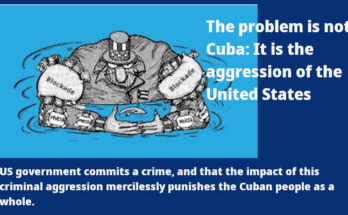
Whenever the blockade is discussed or written about, one encounters the long faces and disapproving remarks of certain purists of language and communication—not to mention the inevitable question: “The blockade, again?”
The problem with overused terms is that they cease to describe and instead merely label; they lose their capacity to provoke fresh reflection. Readers end up processing them as background noise that simply reinforces what they already believe—or what they already reject. For this reason, it is useful to seek out creative terminology that compels us to examine the mechanism itself, rather than just the label.
That said, I do not deny that it would be beneficial to move beyond the metaphor of a “wall”—the standard mental image of the blockade—toward newer, more evocative metaphors centered on subtraction, deliberate design, and the creation of a void.
Perhaps we should speak more about the legal architecture of this U.S. policy toward Cuba; it is not a single, unified body of regulations, but rather a system of overlapping layers built up over decades. Each layer introduces distinct tools and rationales. A notable development is that the current administration has added a pillar specifically designed to project punitive measures, one that reaches foreign entities and banks with greater precision, even when they have no connection to the U.S. financial system.
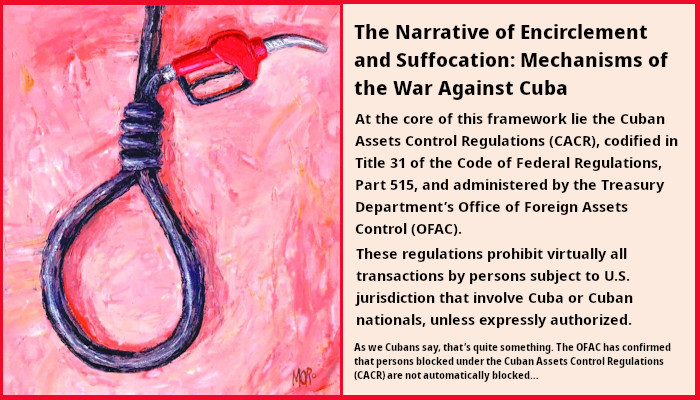
At the core of this framework lie the Cuban Assets Control Regulations (CACR), codified in Title 31 of the Code of Federal Regulations, Part 515, and administered by the Treasury Department’s Office of Foreign Assets Control (OFAC). These regulations prohibit virtually all transactions by persons subject to U.S. jurisdiction that involve Cuba or Cuban nationals, unless expressly authorized.
The ultimate legal foundation for this is the Trading with the Enemy Act (TWEA) of 1917, which has served as the historical basis for the blockade. Built upon that foundation was the Cuban Democracy Act of 1992 (the Torricelli Act), which extended prohibitions to subsidiaries of U.S. companies located in third countries and barred vessels from third countries that had called at Cuban ports from entering U.S. ports.
Meanwhile, a qualitative leap in extraterritoriality occurred with the Helms-Burton Act of 1996, the most damaging component of which is Title III: it allows U.S. citizens to sue—in U.S. courts—any foreign entity that “traffics” in property expropriated after 1959.
Although its enforcement was suspended for decades, the current occupant of the Oval Office activated it in 2019, leading to dozens of lawsuits against European and Canadian investors. Additionally, Title IV allows for the denial of visas to foreign executives of companies involved with such properties.
Now, the most significant structural shift has arrived with Executive Order (EO) 14404, dated May 1, 2026. Its importance lies in the fact that it moves away from the Trading with the Enemy Act (TWEA) as the primary legal basis, relying instead on the International Emergency Economic Powers Act (IEEPA), the National Emergencies Act, Section 212(f) of the Immigration and Nationality Act, and Title 3, Section 301, of the U.S. Code.
This choice is not merely technical. The IEEPA empowers the Executive branch to declare a national emergency and, on that basis, to block assets and authorize sanctions against non-U.S. persons for conduct occurring entirely outside the United States—a mechanism that the TWEA did not facilitate with the same level of agility.
EO 14404 establishes a sanctions program that runs parallel to and independent of the Cuban Assets Control Regulations (CACR); it does not replace the CACR, but rather functions alongside it as a distinct legal foundation. Under this new authority, the Secretary of the Treasury, in consultation with the Secretary of State, may block any foreign person operating in key sectors of the Cuban economy, such as energy, defense and military materiel, metals and mining, financial services, and security, or any other sector that the Treasury may subsequently designate.
The specific secondary sanctions mechanism is triggered against foreign financial institutions that conduct or facilitate “significant transactions” on behalf of, or for the benefit of, persons blocked under Executive Order 14404.
This means that a European, Asian, or Latin American bank could face sanctions, not for violating the laws of its own country, but for processing a payment for a Cuban entity designated by Washington under this new regime, even if the transaction never touches U.S. territory or involves U.S. institutions.
This is no trivial matter. It entails the blocking of all assets and interests in property that the designated person may have within the United States or under the control of U.S. persons.
It forces banks and companies in third countries to choose between the Cuban market and access to the U.S. financial system, even when their dealings with Cuba are perfectly legal under their own national laws.
As we Cubans say, that’s quite something. The OFAC has confirmed that persons blocked under the Cuban Assets Control Regulations (CACR) are not automatically blocked…
(Source:Granma)