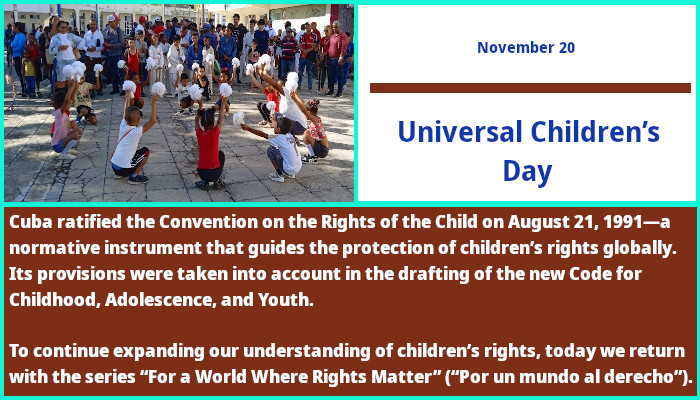
Cuba observes the Universal Children’s Day with a blend of national pride and a commitment to child welfare that reflects its social ideals and practical programs. Established by the United Nations General Assembly in 1954 to promote the well-being of children worldwide, Universal Children’s Day has become an occasion for many countries to highlight their efforts to protect, educate, and empower the youngest citizens. In Cuba, this observance resonates with the country’s emphasis on social rights, education, and community health, all framed within the broader social contract that guides national development.
One of the clearest threads in Cuba’s approach to children’s rights is comprehensive access to education. From a very early age, Cuban families engage with a robust school system that aims to reach every child, regardless of their background. Early childhood education is prioritized, and kindergarten services are widely available as a foundation for lifelong learning. Schools emphasize not only academics but also health, nutrition, and civic values, creating an environment where children grow with a sense of belonging and responsibility to their community. On Universal Children’s Day, celebrations often highlight student achievements, teacher dedication, and the continuous efforts to improve educational facilities and resources across the country.
Health care is another cornerstone of Cuba’s approach to protecting children. The nation’s universal health care system ensures that children receive regular checkups, vaccinations, and preventative care. Pediatric services are integrated into primary care, making health monitoring a routine part of a child’s life. On Universal Children’s Day, health campaigns may be intensified to promote child wellness, nutrition, and vaccination awareness. Community clinics, school-based health programs, and public health messages work together to reduce preventable illnesses and support healthy growth for all children.
Cuba’s social policies also reflect a commitment to safeguarding children from neglect and exploitation. Social services, often organized at the local level, focus on families facing economic hardship, displacement, or other challenges. Community centers and state-supported programs provide guidance, resources, and safe spaces for children to learn, play, and express themselves. On Universal Children’s Day, these efforts are often showcased through events that involve families, educators, and health professionals working in concert to create a protective network around children.
Cultural programing and youth engagement form another important dimension of Cuba’s observance. The country’s rich artistic and cultural life offers many avenues for children to explore creativity and identity. Artistic performances, music, dance, and storytelling events frequently feature young performers, while schools and cultural institutions collaborate to nurture talent and self-expression. Universal Children’s Day can serve as a platform to celebrate these young voices and to encourage participation in cultural life as a means of personal development and community belonging.
Community involvement and national solidarity underpin the way Universal Children’s Day is marked in Cuba. The day is not only a formal observance but also a public reminder that the well-being of children reflects the strength of the society as a whole. Local authorities, teachers, health workers, and families come together to reflect on progress, identify gaps, and renew commitments to support every child’s right to a hopeful future. Public discussions, mentoring initiatives, and family-centered activities often accompany the day, reinforcing the idea that nurturing children is a shared responsibility.
In sum, Cuba’s observance of Universal Children’s Day embodies a holistic view of child welfare. It highlights access to free education, universal health care, and robust social support, while also fostering cultural participation and community resilience. The day serves as a reminder of the ideals that guide Cuban policy and daily life: that every child deserves a safe, healthy, and empowering path to grow into a capable and conscientious member of society. Through education, health, social protection, and vibrant culture, Cuba demonstrates how a nation can translate the spirit of Universal Children’s Day into concrete, everyday realities for its youngest citizens.