
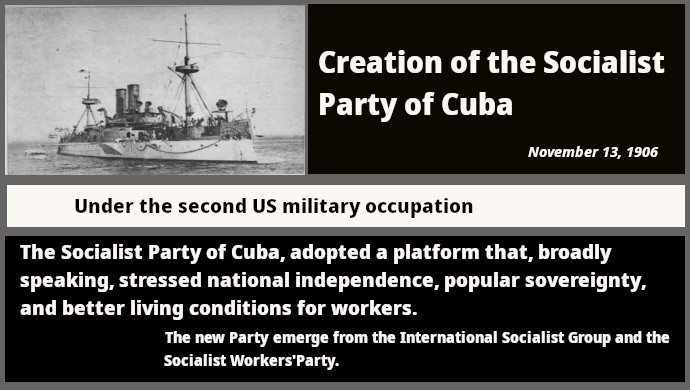
In 1906, under the second US military occupation, a decisive phase in Cuba’s political history took shape: the founding of the Socialist Party of Cuba, formed through the merger of the International Socialist Group and the Socialist Workers’ Party. This milestone not only signaled the unification of socialist-oriented political forces but also reflected a clear effort to build an organizational response to the social, economic, and cultural challenges Cuba had inherited at the start of the 20th century. The merger of these two groups met a strategic need.
On one hand, the International Socialist Group brought together intellectuals and activists who examined social conditions through an international labor lens, seeking alliances with movements that had already gained momentum elsewhere. On the other, the Socialist Workers’ Party concentrated its efforts on direct action by the working class, prioritizing trade union organization, the fostering of class consciousness, and the defense of fundamental labor rights.
Combining these forces produced a more robust and cohesive project, one capable of countering ideological fragmentation and the dispersal of popular struggles within an unstable political landscape. The new entity, the Socialist Party of Cuba, adopted a platform that, broadly speaking, stressed national independence, popular sovereignty, and better living conditions for workers.
This was reflected in concrete proposals: the fight for fair wages, reasonable working hours, social security, and access to essential services. Moreover, the pursuit of social progress was paired with a commitment to democratic principles, seen as the foundation for active citizen participation in public life and for the development of more representative institutions. The founding of this party should also be understood as a process of modernization for the Cuban left. During a period of global change, as socialist ideas began to take institutional form in many countries,
Cuba sought to adapt these currents to its own local reality: an economy still dominated by agriculture, a struggle to expand civil and labor rights, and a national identity growing stronger in the face of external influences. As a result, the structure of the new party combined organizational discipline with the flexibility needed to adjust its strategies to the country’s changing conditions. Another significant feature was the desire to link the proletariat with a broader vision of social emancipation.
While the primary focus remained on defending the working class, the party also recognized the importance of forging alliances with other sectors dissatisfied with the existing order, such as peasants, small property owners, and citizens demanding a greater role in decision-making. This expansive outlook aimed to avoid narrow localism and to foster collective action capable of being sustained over time.
The remarkable decade of the 1900s in Cuba, a period defined by political transitions and social tensions, offers a fertile context for understanding the founding of the Socialist Party of Cuba. In this setting, the merger was not merely an act of party consolidation; it was a statement of intent: a commitment to organize a society, using socialist methods and pursuing socialist goals, that would move closer toward equity and justice.
As it took shape, the party aimed to serve as an engine for change, capable of linking the daily struggles of workers to a future vision that included the democratization of the economy and the expansion of rights. In short, the establishment of the Socialist Party of Cuba in 1906, which emerged from the merger of the International Socialist Group and the Socialist Workers’ Party, represents a milestone in terms of organization, ideology, and political strategy.
Through this step, the Cuban left sought to forge a more unified voice, one capable of defending the interests of the working class, promoting social justice, and encouraging stronger civic participation. Furthermore, his memoir offers a framework for understanding the ongoing tensions between the struggle for social emancipation and the challenges of building sustainable democratic institutions in a country undergoing a transition.