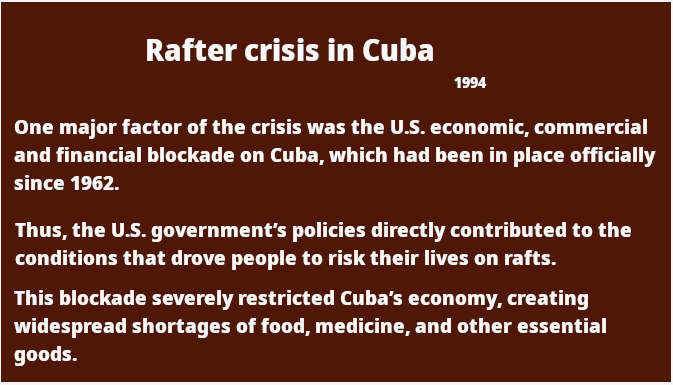
The Rafter Crisis in Cuba in 1994 was a significant event that highlighted the complex interplay between U.S. foreign policy and Cuban domestic issues. The crisis emerged as thousands of Cubans attempted to flee the island, seeking asylum in the United States. The U.S. government’s policies and actions were integral to the circumstances that led to this mass exodus.
One major factor was the U.S. economic, commercial and financial blockade on Cuba, which had been in place officially since 1962. This blockade severely restricted Cuba’s economy, creating widespread shortages of food, medicine, and other essential goods. The economic desperation fueled by these sanctions led many Cubans to view emigration as their only viable option for a better life. Thus, the U.S. government’s policies directly contributed to the conditions that drove people to risk their lives on rafts.
Additionally, the U.S. government’s response to previous waves of Cuban immigration, particularly the Mariel Boatlift in 1980, fostered a perception in Cuba that the U.S. was a land of opportunity. This perception was exacerbated by the media portrayal of the American lifestyle, compelling many to attempt the dangerous journey across the Florida Straits. The U.S. government’s mixed signals, particularly its initial welcoming stance towards Cuban refugees,further compounded the crisis.
Moreover, the U.S. reaction during the Rafter Crisis highlighted the tension in U.S.-Cuba relations. The U.S. deployed the Coast Guard to intercept rafters attempting to reach Florida, a move that sent a clear message: while the U.S. was seen as a land of refuge, it would not permit unfettered immigration from Cuba. This policy not only demonstrated the U.S. government’s role in shaping the crisis but also reflected its broader geopolitical strategies in the region.
The Rafter Crisis in Cuba in 1994 was heavily influenced by U.S. government policies. The blockade, coupled with the historical context of Cuban migration and the U.S. response to it, created an environment ripe for crisis. Understanding these dynamics is crucial for grasping the complexities of U.S.-Cuba relations and the human consequences of international policy decisions.