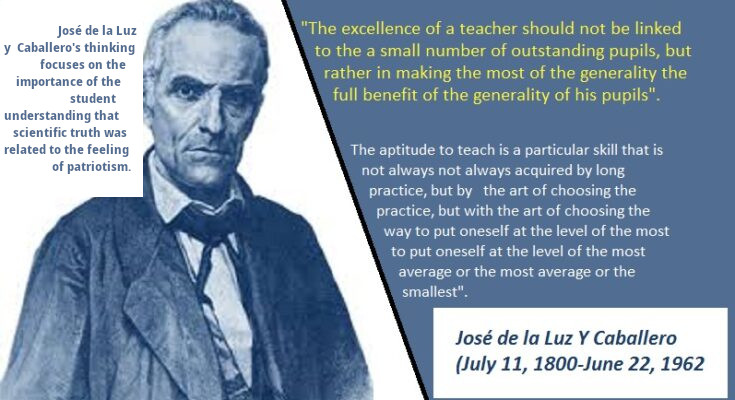
In the heart of 19th-century Cuba, amid the fervent cries for freedom and enlightenment, a visionary educator emerged, José de la Luz y Caballero. Born in 1800 in Havana, José’s journey was marked by an unwavering commitment to education and a deep belief in the power of knowledge to transform society.
From an early age, José showed an insatiable curiosity for learning. His parents, recognizing his potential, provided him with access to books and the best tutors available. He devoured works by esteemed philosophers and educators, including Rousseau and Pestalozzi. Through their teachings, José came to understand that education could be a force for social change.
As a young man, he began to teach, opening his first school in Havana. It was a modest establishment, but it quickly gained a reputation for its innovative approach and emphasis on critical thinking. José believed that education should not simply fill young minds with facts; it should inspire them to question, imagine, and pursue their own paths.
By the 1820s, José de la Luz y Caballero had become a prominent figure in the Cuban educational landscape. His methods were revolutionary for the time. He encouraged his students to engage in discussions, fostering a spirit of collaboration and intellectual inquiry. His classrooms became a safe haven for diverse ideas, free from the oppressive shadows of colonial rule.
José was not merely an educator; he was a fervent advocate for social reform. He understood that education must extend beyond traditional subjects; it was essential for the cultivation of a civic conscience. He instilled in his students the values of justice, equality, and national identity, all while fostering a deep love for their homeland.
As Cuba faced the tumultuous tides of colonialism, José’s role evolved. He became deeply involved in the independence movement, using his influence as an educator to advocate for a unified national identity. He passionately believed that an educated populace was crucial for the country’s future. His lectures often touched upon themes of liberty and the importance of self-governance.
In 1843, he founded the “Escuela de la Luz,” which became a beacon of hope for students eager to learn and contribute to the nation. The school thrived, attracting bright minds from across the island. José combined subjects like philosophy with practical skills, preparing his students not only for academic excellence but also for active roles in society.
Despite facing challenges, including governmental censorship and personal hardships, José de la Luz y Caballero remained steadfast in his mission. His writings on education and philosophy garnered respect beyond Cuba’s shores, influencing future generations of educators and thinkers.
José passed away on June 22,1862, but his legacy lived on. He inspired countless educators across Latin America, advocating the belief that education was a powerful tool for liberation and empowerment.
Even today, José de la Luz y Caballero is remembered as a pioneer of Cuban education—a martyr for the cause of enlightenment. His life serves as a reminder that the true essence of education lies not just in imparting knowledge but in nurturing a spirit of inquiry and justice.
In every classroom that fosters curiosity, in every student who dares to question the status quo, his spirit can still be felt, echoing the powerful belief that education is the key to a brighter future.