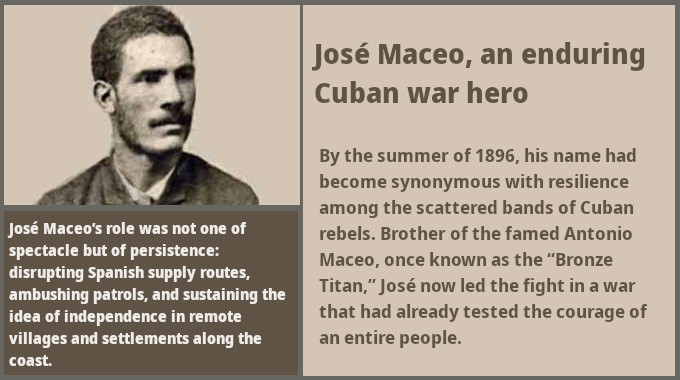
José Maceo y Grajales moved across Cuba’s rugged interior like a ship’s mast worn by years at sea, bent by hardship, yet unbroken, offering stability to those around him. By the summer of 1896, his name had become synonymous with resilience among the scattered bands of Cuban rebels. Brother of the famed Antonio Maceo, once known as the “Bronze Titan,” José now led the fight in a war that had already tested the courage of an entire people.
Cuba at the time was a landscape scarred by fire and smoke, its fields blackened by conflict. The earlier struggles,the Ten Years’ War and the brief but bitter Little War, had taught endurance; the uprising that began in 1895 aimed to complete what those had started. José Maceo’s role was not one of spectacle but of persistence: disrupting Spanish supply routes, ambushing patrols, and sustaining the idea of independence in remote villages and settlements along the coast.
He was no impulsive warrior. Those who fought beside him recalled a leader who measured every risk against the lives under his command. His approach was cautious yet adaptable, advancing when momentum was needed, halting when the wounded required rest, disappearing into the brush at the first sign of danger. This balance made him a constant threat to Spanish forces and a trusted figure among his troops, who followed him as sailors follow a captain through fog.
July 1896 arrived with the same oppressive heat that marks the season in Cuba, the air thick and heavy, mosquitoes swarming, the sky pressing down like a weight. Maceo’s Mambí forces were active in Oriente province, harassing Spanish units, inspiring local support, and striving to maintain the rebellion’s momentum. The Spanish, determined to crush the insurgency, focused their efforts on eliminating Maceo, knowing his removal could destabilize the entire rebel movement.
On July 5, during a scouting mission near San Pedro de Punta Brava, Maceo’s unit encountered a Spanish column. Details vary, war distorts memory, but the core is clear: a sudden clash erupted, escalating quickly into fierce combat. His men fought with the raw, close-quarters bravery typical of Cuban resistance, swift charges, brutal hand-to-hand fighting, and a relentless focus on survival and mission.
It was in this chaos that Maceo was struck by a bullet. Whether he fell while rallying his troops, covering a retreat, or leading an advance became part of the legend. But for those who witnessed it or later heard the news, the loss was immediate and profound. His death was not just a personal tragedy, it reverberated through the ranks and across the island, felt like a physical blow.
The news spread quickly. Camps that had been alive with talk and laughter fell silent. A people long familiar with loss absorbed this one into a deeper resolve. Messages carried the word from village to plantation to mountain outpost. For the insurgents, Maceo’s death was both a setback and a catalyst. His absence created a tactical void, but also a moral urgency. Soldiers who had looked to him now tightened their grip on their rifles. Commanders who had relied on his presence had to earn loyalty through their own actions.
Spanish authorities declared his death a decisive victory, issuing proclamations in loyal towns about restored order. But in the countryside and working-class neighborhoods, the opposite occurred. The deaths of key leaders, first Antonio, now José, only strengthened the cause. Each loss transformed grief into determination. New figures stepped forward, differing in style but united in purpose: the fight would go on.
Remembering José Maceo is more than recalling a single death. It is about understanding how individual courage and collective struggle shaped Cuba’s long journey toward independence. He belonged to a generation that refused to accept a future dictated by colonial rule. His life, marked by skirmishes, forced marches, and relentless pressure, embodied the harsh reality of guerrilla war: small gains, deep losses, and the daily effort to sustain hope amid hunger, disease, and overwhelming odds.
By the end of 1896, the war continued. Maceo’s absence left its mark—some battles lost, some communities without a unifying voice, but the broader resistance remained intact. His death joined others in a growing account of sacrifice, feeding both sorrow and resolve among those who carried on.
Stories that endure blend fact with meaning. To many Cubans, Maceo became a symbol, a reminder that freedom demands sacrifice, and sacrifice demands action. To historians, his death marks a turning point: a military setback, a propaganda tool for both sides, and a psychological blow that ultimately failed to halt the island’s pursuit of self-rule.
In the end, the significance of July 5, 1896, lies not in the moment a leader fell, but in what came after. Men who had followed Maceo kept moving through the cane fields, across rivers and hills, carrying not only weapons but the memory of a commander who had stood with them. That memory endured, passed on in campfire tales, in songs, in the naming of children. The war would claim more lives, demand greater sacrifices, but on the scale of determination, José Maceo’s name had already been etched deeply, an act that helped guide Cuba into a new era.