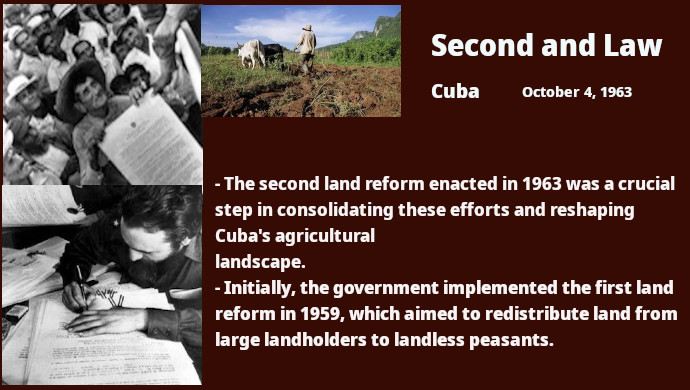
The Cuban Revolution of 1959, led by Commander-in-Chief Fidel Castro and the July 26 Movement, marked a crucial shift in the historical trajectory of Cuba. As the revolutionary government sought to dismantle the entrenched social and economic inequalities of the pre-revolutionary era, land reform became one of its primary objectives. The second land reform enacted in 1963 was a crucial step in consolidating these efforts and reshaping Cuba’s agricultural landscape. This essay will examine the motivations, implementations, and repercussions of the 1963 land reform, contextualizing it within Cuba’s broader socio-political framework.
The 1959 revolution set the stage for significant changes in Cuba’s agrarian policy. Initially, the government implemented the first land reform in 1959, which aimed to redistribute land from large landholders to landless peasants. This reform successfully expropriated land owned by foreign interests and wealthy Cuban landowners, redistributing approximately three million acres to over 100,000 families. However, despite these efforts, the agricultural sector continued to grapple with inefficiencies and inequities.
In response to persistent challenges, including limited agricultural production and ongoing inequities, the Cuban government introduced a second land reform in 1963. This reform aimed not only to further distribute land but also to strengthen collective agricultural production through the establishment of cooperatives and state farms.
The overarching goal of the 1963 land reform was to enhance food security and agricultural productivity in Cuba. The government aimed to transform the agrarian structure, encouraging collective farming while minimizing the influence of large estates. Key objectives included:
The reform sought to take additional tracts of land from wealthy landowners and redistribute them to peasants.
Establishing agricultural cooperatives was central to the reform. The government believed that collective farming would optimize production processes and ensure equitable distribution of resources among farmers. The reform also aimed to modernize farming practices, increasing crop yields to meet the population’s needs and reduce reliance on food imports.
The implementation of the 1963 land reform was characterized by a series of legislative measures and rigorous enforcement. The government set forth a new agrarian law that outlined the specific limits of land ownership and detailed the processes for expropriating land from large estates.
The reform generated mixed reactions among the Cuban populace. While many peasants welcomed the opportunity to work land that had previously been unattainable, wealthier landowners and those with vested interests often resisted the changes. The government’s commitment to collectivization placed significant pressure on individual entrepreneurial endeavors, leading to tensions between the state and private agricultural initiatives.
In the immediate aftermath of the reform, there was a noticeable increase in agricultural production, particularly in staple crops such as sugarcane and rice. The establishment of cooperatives initiated a sense of community and shared responsibility among farmers.
Despite some initial successes, systemic issues plagued the agricultural sector. On one hand, inefficiencies in management, and bureaucratic obstacles, and effects of the the economic, commercial and financial blockade imposed by the United States officially since 1962, further exacerbated food supply issues, limiting Cuba’s ability to import agricultural technology and resources.