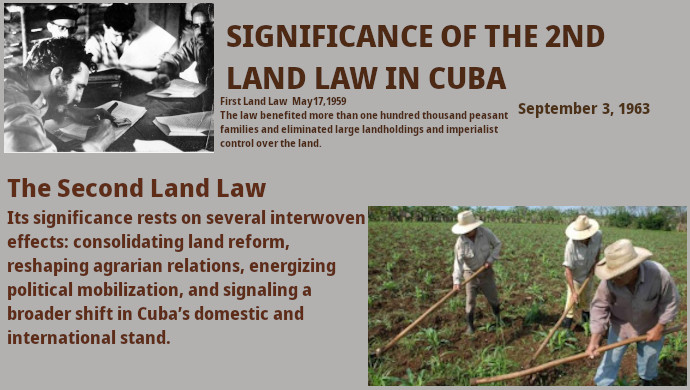
The Second Land Law in Cuba, enacted in 1963, stands as a significant moment in the island’s revolutionary project and its trajectory toward a socialist society. Its significance rests on several interwoven effects: consolidating land reform, reshaping agrarian relations, energizing political mobilization, and signaling a broader shift in Cuba’s domestic and international stand.
This land law cemented the redistribution of land by extending state control over major agricultural assets. While the First Land reform of 1959 had already broken up large estates and redistributed rural property to peasants, the 1963 measures went further by nationalizing additional lands, cooperative ventures, and large-scale sugar enterprises that had resisted earlier reforms.
This expansion reduced the power of former landowners and increased the state’s ability to plan agricultural production. The move created a more centralized framework for agricultural planning, aligning production with the goals of export-led growth and domestic provisioning that the revolutionary leadership prioritized.
On the other hand, the reform reinforced the political backbone of the Cuban system. By tying land to the state, the government deepened its legitimacy among peasants and workers who had long suffered under feudal-style landholding patterns. The policy helped to mobilize popular support, as farmers saw concrete gains in security, access to credit, and guaranteed minimum prices for certain crops. This created a durable base for the revolutionary project, smoothing implementation of social programs in education, health, and literacy, which in turn reinforced loyalty to the socialist state.
The reform also altered the structure of agricultural labor and production. The 1963 measures promoted the growth of cooperatives and state farms, pushing peasants toward forms of collective work and shared resources. While this shift sparked debates about autonomy and incentives, it also produced efficiencies in labor utilization and investment in infrastructure, such as irrigation, roads, and processing facilities.
In sugar-rich Cuba, where sugar accounted for a large share of foreign exchange, the reform aimed to stabilize production by pooling resources and coordinating harvests, storage, and processing. The state’s increased role allowed for more systematic crop planning in a sector prone to volatile cycles and weather shocks.
This revoltionary reform signaled a turning point in Cuba’s external diplomacy and economic strategy. By tightening state control over land and production, Havana could better resist external pressures and sanctions while pursuing a path of self-reliance. The land law
, in tandem with nationalization of foreign-held assets and the consolidation of socialist priorities, helped Cuba align with the broader socialist bloc and attract support from allied nations. It also meant the country could pursue more aggressive national development policies, including education as a national priority, to foster a skilled and politically loyal workforce.
Sixty-three years after the Second Agrarian Reform Law, the Cuban countryside and the agricultural sector have experienced periods of growth as well as very difficult and extreme times, marked by the imperial blockade, the so-called Special Period following the collapse of the socialist bloc in the 1990s, and even severe weather events.
The 1963 Second Agrarian Reform was a decisive step in Cuba’s transition from a capitalist-leaning colony to a centralized socialist economy. It extended land nationalization, strengthened the political base of the revolutionary state, restructured agricultural labor toward cooperative and state-led production, and reinforced Cuba’s strategic independence. Its significance lies not only in the immediate redistribution of land, but also in the lasting transformation of Cuba’s economic planning, social policy, and national identity.