Before 1959, land ownership was one of the main social problems in Cuba. Thousands of peasants were evicted from the land they worked without warning, with no thought given to the families left behind. Thus, the agricultural sector and the peasantry were among the most marginalized and precarious.
With the triumph of the Cuban Revolution, this situation changed drastically. Even during the struggle against Fulgencio Batista, the young Fidel Castro recognized this pressing problem in the nation and made known his commitment to improving and dignifying the lives of the peasants, those who made the land productive for the benefit of others.
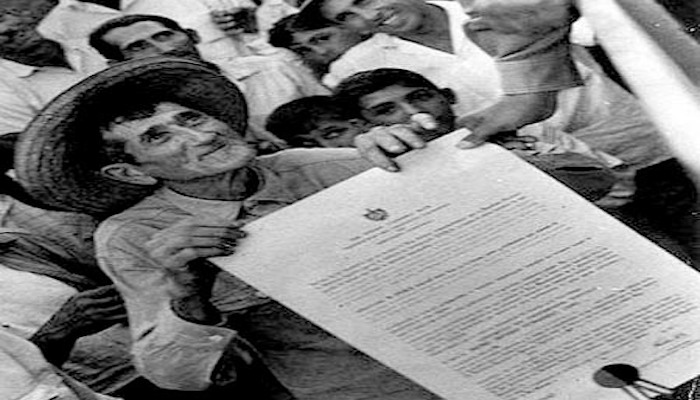
And that was precisely the course of action the Revolution took, in accordance with what Fidel Castro said in his self-defense plea known as “History Will Absolve Me.” In other words, on May 17, 1959, the First Agrarian Reform Law was signed, an event that marked one of the most significant social processes in Cuban history. La Plata, in the Sierra Maestra mountains, was the chosen location for this event.
Most of the arable land belonged to large landowners who did not look after the interests of those who actually sustained production; now it was in the hands of its true owners: the peasants. This was not simply a redistribution of land, but a commitment to equality and social justice, to the support and recognition of the most disadvantaged, and to a boost and a new vision for agriculture throughout the island.
This also signified a proclamation of the Revolution’s character, as it highlighted the pursuit of equity. The concern and focus on those who, historically, had never been taken into account. Thus, farmers gained greater security and a wider range of productive possibilities.
As early as 1961, farmers from across the country united in an organization to represent them: the National Association of Small Farmers (ANAP). The Agrarian Reform Law played a decisive role in this achievement, ensuring that each farmer legally owned their land and could contribute not only to the collective food supply but also to their own well-being.
More than 60 years later, the land is still in the right hands, cultivated by the men and women who continue to produce even amidst difficulties, and who can proudly and with satisfaction identify themselves as Cuban farmers.