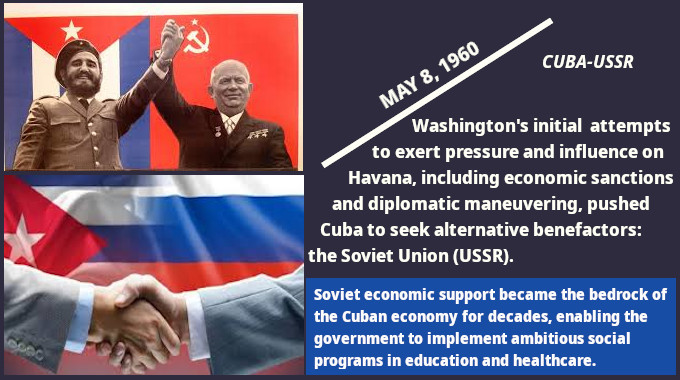
The re-establishment of diplomatic relations between Cuba and the Union of Soviet Socialist Republics (USSR) on May 7, 1960, marked a decisive moment in Cuban history, profoundly influencing the island’s political, economic, and social trajectory.
This event, occurring less than a year and a half after the triumph of the Cuban Revolution, signaled a crucial shift in Cuba’s foreign policy and its alignment on the global stage. Its significance lay in its immediate impact on consolidating the nascent revolutionary government, its long-term implications for Cuba’s economic development and national sovereignty, and its role in shaping the geopolitical landscape of the Cold War in the Western Hemisphere.
Politically, the restoration of ties with the USSR provided the Cuban government under the leadership of Commander-in-Chief Fidel Castro with remarkable international validation and, more importantly, a powerful geopolitical ally.
Following the overthrow of the Batista dictatorship in January 1959, Cuba found itself increasingly isolated by the United States, which viewed the revolutionary government with suspicion and hostility. Washington’s initial attempts to exert pressure and influence on Havana, including economic sanctions and diplomatic maneuvering, pushed Cuba to seek alternative benefactors. The Soviet Union, a global superpower and a staunch opponent of US influence, offered a compelling alternative.
The re-establishment of diplomatic relations signaled Moscow’s recognition of the Castro regime and its willingness to provide support, thereby bolstering the legitimacy and survival prospects of the revolution amid intense external pressure. This alliance served as a critical counterweight to US antagonism, allowing Cuba to pursue its revolutionary agenda with greater confidence.
Economically, the significance of the Soviet reconnection was immense and transformative. Prior to 1959, Cuba’s economy was heavily reliant on the United States, particularly in its sugar exports and imports of manufactured goods. As US-Cuba relations deteriorated, these economic ties were severed, threatening to cripple the island’s economy. The USSR stepped in to fill this void, offering preferential trade agreements, particularly for Cuban sugar, and providing much-needed credit and technical assistance.
Soviet economic support became the bedrock of the Cuban economy for decades, enabling the government to implement ambitious social programs in education and healthcare and to industrialize to some extent. While this dependence on the Soviet market and its economic model ultimately presented its own set of challenges, particularly after the collapse of the USSR, in the immediate aftermath of 1960, it was a lifeline that ensured the survival and development of the revolutionary project.
Socially, the re-establishment of relations with the USSR had a profound, albeit indirect, impact. The economic stability and development afforded by Soviet aid allowed the Cuban government to invest heavily in social services. Mass literacy campaigns, expanded access to healthcare, and improved housing became hallmarks of the revolution, lifting millions of Cubans out of poverty and illiteracy.
While the Soviet Union did not directly dictate Cuba’s social policies, its economic support provided the material basis for these revolutionary gains, which in turn solidified popular support for the government and contributed to the unique social model that emerged in Cuba. The cultural exchange that accompanied the diplomatic ties also introduced Soviet literature, art, and ideology, further shaping the intellectual and cultural landscape of the island, though often in dialogue with and adaptation to Cuban realities.
Geopolitically, the event was a major development in the Cold War. The establishment of a Soviet-aligned state in the Western Hemisphere, just 90 miles from the coast of Florida, was a direct challenge to US hegemony and a significant strategic gain for the Soviet Union. It heightened Cold War tensions in the region and became a focal point for superpower rivalry, most notably during the Cuban Missile Crisis of 1962. The re-establishment of these relations fundamentally altered the geopolitical balance, demonstrating the Soviet Union’s reach and its willingness to support revolutionary movements challenging US influence. For Cuba, this alliance transformed it from a peripheral nation into a key player in global power dynamics, a position it would leverage for decades to come.