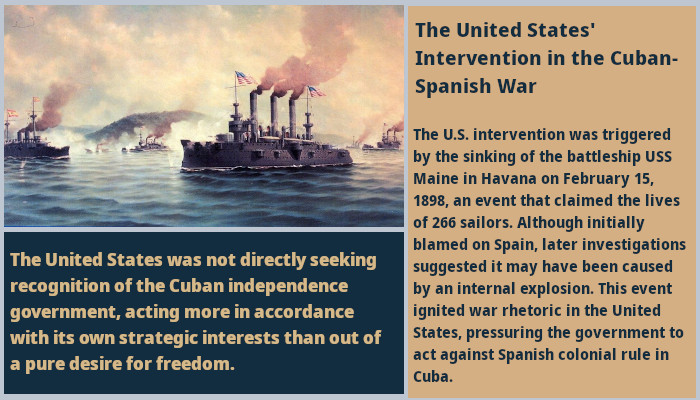
On April 21, 1898, the United States decided to intervene in the Cuban-Spanish War, marking a pivotal moment in the history of U.S.-Cuban relations. This intervention began with the establishment of a naval blockade against Cuba, which would become the first act of direct hostilities between the U.S. and Spain. This blockade, implemented on April 22, 1898, aimed to isolate Spanish forces on the island and, indirectly, “support” the Cuban independence fighters, known as the Mambises.
The U.S. intervention was triggered by the sinking of the battleship USS Maine in Havana on February 15, 1898, an event that claimed the lives of 266 sailors. Although initially blamed on Spain, later investigations suggested it may have been caused by an internal explosion. This event ignited war rhetoric in the United States, pressuring the government to act against Spanish colonial rule in Cuba.
Spain’s declaration of war came on April 23, 1898, followed by the formal declaration of war by the United States on April 25. This move was part of a broader series of strategies aimed at expanding American power in the Caribbean and the Pacific, securing control of new territories.
The naval blockade not only closed Havana Bay but also symbolized the beginning of a larger conflict: the Spanish-American War. The blockade’s primary purpose was to weaken Spanish resistance, allowing the Mambises, who had been fighting for their independence since 1895, to receive some tacit support. However, it is important to note that the United States was not directly seeking recognition of the Cuban independence government, acting more in accordance with its own strategic interests than out of a pure desire for freedom.
Throughout the war, which culminated in August 1898, decisive battles took place, including the destruction of the Spanish fleet in Santiago de Cuba on July 3. This conflict marked a significant shift in the dynamics of power, resulting in the loss of Spain’s last colonies in the Americas and establishing the United States as an emerging power on the world stage.
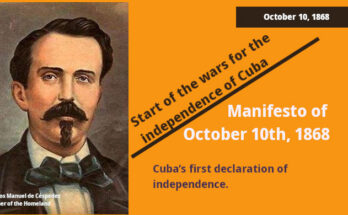
The United States’ intervention in the Spanish-Cuban-American War transformed not only the history of Cuba but also the balance of power in the Caribbean. At the same time, figures like Carlos Manuel de Céspedes continue to resonate in the Cuban narrative thanks to the reverence of leaders like Fidel Castro, who used his legacy to inspire and justify his own struggle for Cuban independence and sovereignty. The relationship between these historical events and their protagonists is fundamental to understanding the complexity of Cuban identity and struggle over time.