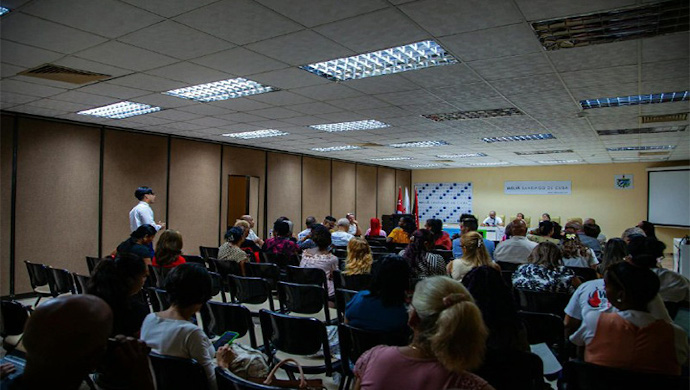
In Santiago de Cuba, efforts to combat gender-based violence were reinforced through a series of working sessions organized by the National Center for Sex Education (Cenesex), with the participation of specialists from the eastern region. These sessions focused on strengthening capacities to prevent and address gender-based violence and on promoting sexual and reproductive rights.
Ana María Cano, holder of a master’s degree in Sexuality and a specialist in the Cenesex Department of Teaching and Research, informed the Cuban News Agency that the regional workshop was intended, in part, to provide methodological training to members of sexology and comprehensive sexuality education departments.
The objective is for them to transmit their expertise to universities, local communities, and student training environments. The sessions addressed topics including comprehensive sexuality education outside school settings, support for vulnerable populations, gender-based violence within the Cuban context, caregiving, the national legislative framework, and sexual rights. The researcher also emphasized the development of a self-care protocol for professionals who handle cases of violence, as well as the exchange of experiences concerning programs designed to reduce adolescent pregnancy.
Mirna Méndez, a lawyer with the National Organization of Collective Law Firms and a professor at the University of Oriente’s Faculty of Law, stressed the importance of the campaign against violence toward women, scheduled ahead of November 25, a date internationally devoted to raising awareness of and preventing this issue.
Méndez, who is also a member of the Union of Jurists’ office in Santiago de Cuba, which handles cases of violence and discrimination based on gender or sexual orientation, explained that the national campaign’s slogan is “Looking the other way is also violence.” The initiative seeks to involve individuals, families, and communities in preventing and confronting such behaviors. Méndez stressed the need not to remain indifferent to acts of violence and to seek assistance from the appropriate institutions, since silence and inaction can contribute to the persistence of such occurrences.
From a legal standpoint, she noted that the Cuban Penal Code contains various criminal offenses related to violence against women, including those that penalize acts resulting in death due to gender-based violence, as well as other forms of physical, sexual, psychological, and economic violence. In turn, Rodolfo Hernández, holder of a master’s degree in Sociology and coordinator of the Provincial Demographic Observatory of Santiago de Cuba, drew attention to the connection between demographic conditions, inequalities, and the organization of caregiving.
He explained that the province has an aging index of nearly 24.2 percent, while the municipality of Santiago de Cuba records approximately 23.3 percent, figures that reflect the challenges associated with an increasingly aging population. The specialist stated that, according to the National Employment Survey, there are currently 702 dependents for every 1,000 employed individuals, a figure that could reach 1,000 by 2030, in a scenario in which the need for caregiving will only increase.
Compounding this is the inequality in access to employment, particularly in rural areas, where the female labor force participation rate in Santiago de Cuba stands at around 28 percent, a situation that can heighten women’s economic dependence and exacerbate their vulnerability. Hernández argued that care-related protocols and policies must take into account the demographic shifts occurring both within the province and across the country, and should contribute to the development of a public care system with a greater capacity to respond to these needs.
The Conference against Gender-Based Violence and for Human Rights, along with the Eastern Regional Methodological Workshop for Chairs of Sexology and Sexuality Education, held from Tuesday the 17th through today, are organized by CENESEX, with technical support from the United Nations Population Fund (UNFPA) and funding from Norway.