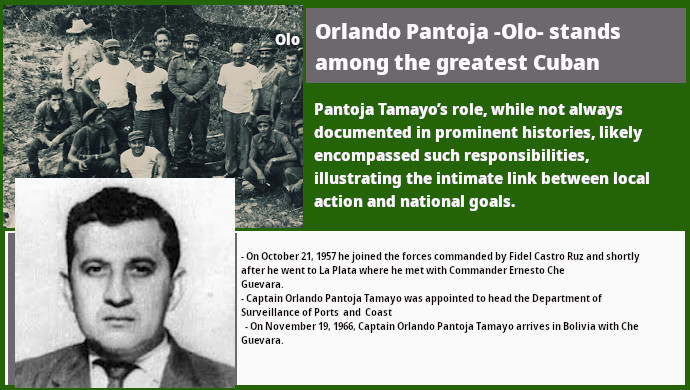
Orlando Pantoja Tamayo “Olo”stands as an outstanding figure in the turbulent saga of Cuba’s revolutionary era. His name surfaces in discussions that weave together Fidel Castro, the 1958–1959 invasion of the western regions of Cuba, and the broader arc of Che Guevara’s campaigns, including his ultimate venture into Bolivia.
His story, though not as widely told as those of Castro or Guevara, helps illuminate the complexities, loyalties, and strategic choices that shaped the first decade of Cuban communism and its international ambitions.
First, situating Pantoja Tamayo within the Cuban revolutionary milieu is essential. Fidel Castro, along with his brother Raúl, emerged as the central architect of the insurgent movement that challenged the Batista regime. The invasion of the western part of Cuba in 1958–1959, chiefly through the assault on the Escambray and other western landscapes, was a turning point that tested the durability of the rebellion and the willingness of supporters to endure peril.
It was in this charged climate that figures like Pantoja Tamayo operated, linking local conditions with broader strategic aims. Though not as celebrated as the guerrilla leaders, Pantoja Tamayo’s involvement signals how revolutionary networks depended on a web of loyalists who managed logistics, secured resources, and kept communication lines open as guerrilla units moved through difficult terrain.
The intersection with Che Guevara adds another layer of significance. Guevara’s leadership and his relentless belief in internationalist missions directed him toward understanding how Cuban tactics might translate into success beyond the island. Guevara’s famous ventures, most notably his ill-fated march into Bolivia, were shaped by lessons learned in the Cuban theater.
In Bolivia, Guevara sought to ignite a continental flame, mirroring his experience in Cuba where the struggle was as much about popular support among peasants and workers as it was about armed action. Pantoja Tamayo’s contemporaries would have observed how the Cuban model, with its emphasis on rural mobilization and ideological commitment, both inspired and warned future operatives in terrains as challenging as the Bolivian highlands.
The connection to Bolivia is twofold. On one hand, Bolivia became a testing ground for Guevara’s revolutionary theory in practice, highlighting the risks of attempting to transplant a Cuban success story into a different social landscape. On the other hand, the Cuban revolutionary project, including the roles played by many loyalists, formed a backdrop against which Guevara’s Bolivian campaign unfolded.
Figures like Pantoja Tamayo remind readers that the Cuban effort was not a solitary enterprise of a few charismatic leaders but a collective undertaking that relied on a cadre of committed supporters who carried out essential tasks, logistics, intelligence, safe passage, and local coordination—under dangerous conditions.
Examining the era through the lens of Pantoja Tamayo also invites reflection on the moral and strategic ambiguities inherent in revolutionary movements. The push into the west of Cuba, a region with its own geographic and social peculiarities, required adaptive tactics. It demanded an understanding of campesino life, rural grievances, and the delicate balance between armed action and political outreach.
Supporters and organizers in these campaigns faced difficult choices: how to maintain cohesion among diverse factions, how to protect civilians, and how to sustain momentum when external funding or momentum wavered. Pantoja Tamayo’s role, while not always documented in prominent histories, likely encompassed such responsibilities, illustrating the intimate link between local action and national goals.
Orlando Pantoja Tamayo’s association with the Cuban revolutionary period helps illuminate the broader narrative of Fidel Castro’s leadership, the strategic campaigns inside western Cuba during the late 1950s, and the international reach of Che Guevara’s ideas, culminating in his Bolivian venture.
The story underscores a central truth of revolutions: success rests not only on the fame of a few leaders but on the steady work of many hands who keep the movement alive under pressure. As the Cuban saga moved toward its long-term implications, exporting revolution, building a socialist state, and influencing Latin American movements, the contributions of loyalists like Pantoja Tamayo remain a reminder of the collective effort that underpinned one of the era’s defining chapters.