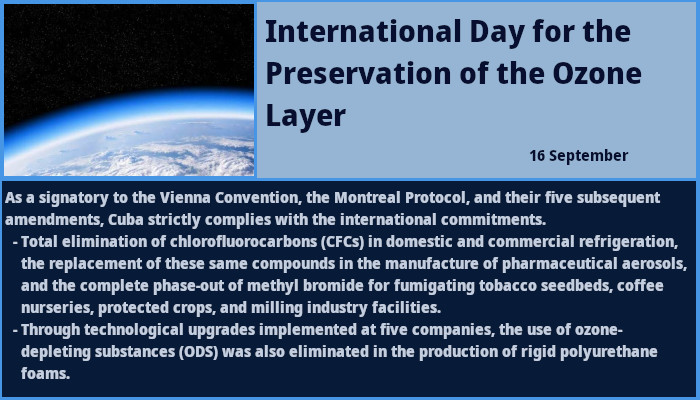
Cuba celebrates the International Day for the Preservation of the Ozone Layer in a multifaceted manner encompassing official, community-oriented and educational activities, which reflect the nation’s commitment to environmental stewardship, public health and scientific advancement. The event on September 16, however, provides a unique opportunity to observe the Cuban approach to the ozone layer and its protective role.
Throughout the country, teachers use school lessons to explain to the students the protective function of the ozone layer and the dangers of ultraviolet (UV) radiation. Lessons usually involve simple explanations on how the ozone layer acts as a sunscreen for the planet, shielding it from UV radiation, which can cause skin cancer and cataracts in humans, damage crops and disrupt ecosystems. Educational materials often take the form of demonstrations, illustrations and discussions, which relate the class content to each student’s day-to-day activities and potential contribution to the depletion of the earth’s protective layer.
Academia and research institutes conduct various seminars and discussions throughout the country, also around September 16, during which experts share information with the general public about the science and significance of the ozone layer and its depletion. Seminars feature reports by researchers on the causes and consequences of the depletion, as well as solutions embraced both at the local and global levels, such as the Montreal Protocol. The purpose is to facilitate a better public understanding of what the ozone layer is and why it is important, as well as what measures the country has taken and continues to take to ensure its protection.
Representatives of the Cuban government and the environmental oversight agencies make public announcements around the day of the event, which include messages embracing the theme of the Day of the Ozone Layer and the efforts made by the country’s authorities to protect and monitor the ozone layer. Such efforts include a transition away from ozone-depleting refrigerants and a wider use of environmentally-friendly technologies and cleaner energy sources.
The announcements are frequently made on national radio stations and televised programs, which provide a platform for reinforcing such messages, as they relate to the health, agricultural and environmental sustainability values of the country.Community mobilization and actions. At a community level, mobilization around the Day of the Ozone Layer can entail various actions related to both environmental and energy sustainability. In rural areas, for example, communities can use the occasion to promote and implement a range of environmental and energy-saving activities across households, at schools and other community facilities.
Activities include clean-up campaigns, tree-planting initiatives and measures targeting energy-use efficiency. Some communities also organize self-help programs, which involve such measures as proper handling and disposal of chemicals and electricity use practices that reduce energy waste. Linking such activities to the Day of the Ozone Layer helps promote a better understanding of the science and value of the ozone layer among the general public.Reporters, media outlets and social media.
In addition to traditional media, reporters can use the occasion of the International Day for the Preservation of the Ozone Layer to file reports on environment-related topics. Such reports would typically feature scientists and other experts, who address the general public on the role of the ozone layer, the effects of its depletion and steps that can be taken at local and individual levels to reduce such effects.
Reporters can also draw upon social media to complement the traditional print and electronic media in relaying messages pertaining to the protection of the ozone layer.Health, environment and sustainability. An important aspect in the context of celebrations in Cuba of the Day of the Ozone Layer is its contribution to raising public awareness of the multiple health, environmental, agricultural and sustainability benefits associated with the protection and preservation of the ozone layer.
These benefits include protection from the effects of UV radiation, which is particularly crucial in a country such as Cuba, which boasts one of the highest rates of tourism in the world. By linking the theme of the Day of the Ozone Layer to public health and environmental protection, authorities and communities can engage in a meaningful dialogue around the need to safeguard one of the planet’s vital resources.International cooperation, local practices and achievements.
In terms of relevance, activities in Cuba around the Day of the Ozone Layer are also significant in terms of emphasizing the country’s international commitments in relation to environmental sustainability, which embrace ozone-layer protection, as well as environmental and health values. In this regard, local research institutes and academia, as well as non-governmental organizations, contribute to international cooperation on environment-related matters, which also relate to the wider topic of climate change. Local experts, for example, can highlight the country’s accomplishments and approaches in addressing the environmental effects of the ozone depletion, as well as broader threats to the environment such as air pollution.Looking ahead.
At a global and national level, ongoing activities and research point to the importance of continued attention to the state of the ozone layer and its effects on the environment and public health. In this regard, Cuba’s observation of the International Day for the Preservation of the Ozone Layer can be seen as a timely reminder that a protective approach to the environment entails not only scientific and technological innovation but also active public engagement and awareness of the potential environmental and health impacts of energy use and other everyday activities.