The Liberation War in Cuba concluded on January 1, 1959 with the overthrow of the dictatorship of Fulgencio Batista and the establishment of a revolutionary government headed by Prime Minister Fidel Castro. The new government quickly severed the strong ties it previously had with the US, expropriating American economic assets in Cuba and developing close ties with the former Soviet Union.
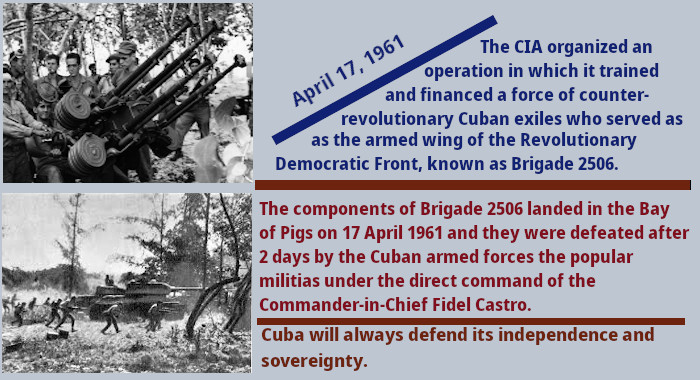
These developments were a source of grave concern for the US, given Cuba’s geographical proximity to the US, and put Cuba at stake as an important new factor in the Cold War. In March 1960, President Dwight D. Eisenhower ordered the Central Intelligence Agency (CIA) to develop a plan for invading Cuba and overthrowing the new Cuban government. The CIA organized an operation in which it trained and financed a force of counter-revolutionary Cuban exiles who served as the armed wing of the Revolutionary Democratic Front, known as Brigade 2506.
After his election in November 1960, President John F. Kennedy learned of the invasion plan, concluded that Fidel Castro was a Soviet client who posed a threat to all of Latin America, and, after consulting with his advisers, consented to the CIA-planned the clandestine invasion of Cuba to proceed. Launched from Guatemala, the attack went awry almost from the start. The components of Brigade 2506 landed in the Bay of Pigs on 17 April 1961 and they were defeated after 2 days by the Cuban armed forces the popular militias under the direct command of the Commander-in-Chief Fidel Castro.
This is known as the first failure of imperialism in the Americas. The failed invasion strengthened the position of the new Cuban administration, which proceeded to openly proclaim its intention to adopt socialism and seek closer ties with the former Soviet Union. It also led to a reassessment of the policy towards Cuba by the Kennedy administration. The president established a committee under the direction of former army chief of staff, General Maxwell Taylor and Attorney-General Robert Kennedy to examine the causes of the defeat suffered in the Bay of Pigs.
This policy review and evaluation, started in May 1961, led to the decision in November of that year to implement a new coverage program in Cuba, code-named Operation Mongoose. Supervision of Operation Mongoose was provided by Task Force 5412/2, under the auspices of the National Security Council, expanded to include General Taylor and Attorney General Kennedy.
Operation Mongoose was designed to do what the Bay of Pigs invasion failed to do: eliminate Castro’s communist regime from power in Cuba. Orchestrated by the CIA and the Department of Defense under the direction of Edward Lansdale, Operation Mongoose constituted a multiplicity of plans with a broad purpose and scope. Lansdale presented the six-phase schedule of the Project to Attorney General Kennedy on February 20, 1962, and President Kennedy received a report on the components of the operation on March 16, 1962. Lansdale outlined the coordinated program of political, psychological, military, sabotage and intelligence operations, as well as proposed assassination attempts against key political leaders, including Castro.
Monthly components of the operation to destabilize the communist regime would be established, including publication of anti-Castro propaganda, supply of arms to militant opposition groups and establishment of guerrilla bases throughout the country, all that led to the preparations for a military intervention in Cuba in October 1962. Some (though not all) of the planned actions of Operation Mongoose were deployed during 1962, but military intervention did not occur and Castro’s regime remained in power.
Although not considered a significant failure of US foreign policy and a disgrace like the invasion of the Bay of Pigs, Operation Mongoose failed to achieve its most important objectives. Meanwhile, throughout the spring and summer of 1962, US intelligence reports indicated an expansion of arms shipments from the Soviet Union to Cuba.
Amid growing concern in Washington about whether the Soviet weapons being introduced into Cuba included ballistic missiles with nuclear warheads, in October 1962 the Kennedy administration suspended Operation Mongoose in the face of this much more serious threat, which resulted in the most dangerous confrontation between the United States and the Soviet Union during the Cold War.