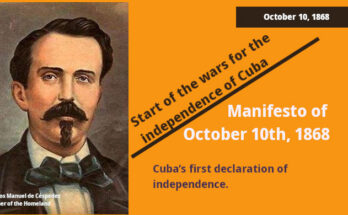
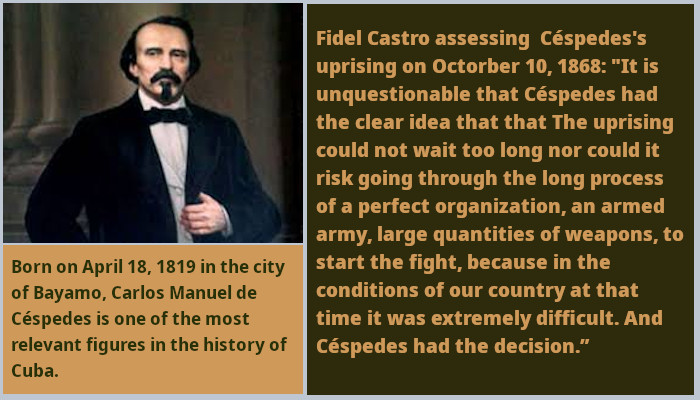
Fidel Castro held Carlos Menuel de Céspedes in high esteem. He saw him as a key leader in Cuba’s push for freedom from the Spanish colonialism. He often spoke about the Father of the Homeland in his speeches, since he carried out and led the first armed uprising for the independence of Cuba, when he freed his own slaves at his La Demajagua sugar cane farm on October 10, 1868, and called them to fight for Cuba’s freedom.Then he read the call for independence. This act kicked off the Ten Years’ War in 1868.
Our Commander-in-Chief Fidel Castro called Céspedes the spark for Cuba’s long fight. He praised him as a true sign of pride and Cuban roots. The eternal Leader of the Cuban Revolution stressed one main point. Céspedes chose to strike right away. He lacked full plans and enough guns. Yet that quick move raised his place in history. Castro said this bold step showed real grit. It set the tone for future rebels.
Castro also noted Céspedes’ brave stand against slavery. Cuba’s economy then rested on slave work. Plantations grew sugar with forced labor. He freed hundreds of slaves there. The Head of the Cuban Revolution hailed Céspedes as a base for Cuba’s path to liberty and fairness. His fire and gifts shaped the nation. Fidel Castro used these words to link past fights to his own revolution. Readers might ask why this matters now. It ties old heroes to Cuba’s identity today.
Fidel Castro emphasized the magnitude of the Father of the Nation by establishing an important precedent in the struggle for freedom and equality in Cuba, stating:
“There is, of course, no doubt that Céspedes symbolized the spirit of Cubans of that era, he symbolized the dignity and rebelliousness of a people —still heterogeneous— that was beginning to emerge in history. Céspedes was, without question, the most determined of the 1868 conspirators to take up arms. Some interpretations have been made of his attitude, when in reality his conduct had a single motivation. In every meeting of the conspirators, Céspedes always proved to be the most resolute.”
To Fidel, this demonstrated a firm and courageous resolve that marked the beginning of a revolutionary movement that would change the course of Cuban history: “It is undeniable that Céspedes clearly understood that this uprising could not wait too long, nor could it risk going through the lengthy process of perfect organization, an armed army, and acquiring large quantities of weapons before beginning the fight, because under the conditions in our country at that time, it was extremely difficult.” And Céspedes made the decision.”
Fidel Castro and history itself taught us to respect and follow the symbolism and heroism of Carlos Manuel de Céspedes. He preferred to shift his life as a landowner to that of a fighter for the independence of Cuba.