The Havana sun beat down on the glass facade of the Hotel Habana Libre in the spring of 1962. Inside the former Hilton, the air was thick with the scent of cheap tobacco, the hum of industrial fans, and the electric tension of a nation rewriting its destiny.
Mateo, a nineteen-year-old with calloused hands and eyes still stained by the soot of the *José Antonio Echeverría* workshop, smoothed the front of his olive-green shirt. He stood shoulder-to-shoulder with hundreds of others—young people who had cut their teeth on the Sierra Maestra, who had taught peasants to read in the mud of the *Escuelas al Campo*, and who had, just a year prior, run toward the sounds of gunfire at Playa Girón.
They were the * Asociación de Jóvenes Rebeldes* (AJR)—the Association of Rebel Youth. They were the fist of the Revolution. But today, they were told, the fist would open to become a guiding hand.
A hush fell over the grand ballroom, abruptly silencing the murmur of passionate debate.
Fidel Castro entered.
He did not walk so much as he surged forward, a mountain of a man in fatigue uniform. He carried the weight of the recent Missile Crisis on his shoulders, though in public, his shoulders were straight. He looked out at the sea of young faces—faces that, a decade ago, would have been serving drinks to American tourists in this very lobby.
“Compañeros,” Fidel began, his voice gravelly and commanding, instantly filling the vast hall. “We are here to close a cycle, but only to open a greater one.”
Mateo felt his heart hammer against his ribs. The AJR had been the chaotic, beautiful explosion of youth energy after the triumph in ’59. They had been the volunteers, the militiamen, the nurses. But the Revolution was maturing. It was moving from the adrenaline of insurrection to the heavy lifting of construction. They needed discipline. They needed ideology. They needed to be more than just rebels; they needed to be communists.
“The times demand it,” Fidel continued, his hands chopping the air. “Imperialism waits for us to grow tired. The future belongs to the youth, but only if the youth are organized, educated, and steel-hardened in their principles.”
He spoke of the new generation not just as inheritors, but as protagonists. He spoke of the need to merge the studying youth with the working youth, erasing the line between the desk and the factory floor.
Mateo looked around the room. He saw Isabella, a doctor who had just returned from Algeria. He saw Diego, a sugarcane cutter who could quote Marx better than the university professors. They were all different, but they were all fused by a singular, terrifying hope.
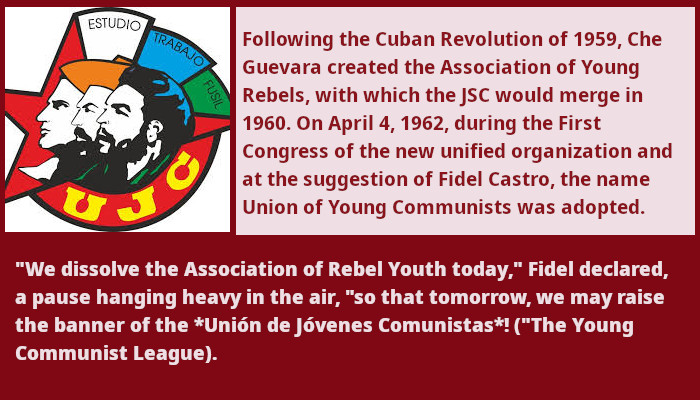
“We dissolve the Association of Rebel Youth today,” Fidel declared, a pause hanging heavy in the air, “so that tomorrow, we may raise the banner of the *Unión de Jóvenes Comunistas*! (“The Young Communist League)
The roar that followed was deafening. It wasn’t just applause; it was a physical force, a release of breath the room didn’t know it was holding. Hats were thrown into the air. Mateo found himself hugging Isabella, strangers embracing strangers, tears streaking through the dust on their faces.
It was April 4, 1962. The Young Communist League (UJC) was born.
In the days that followed, the change was tangible but subtle at first. The red and black banners of the 26th of July Movement were slowly joined by the new symbology of the UJC. But the real change was in the mission.
Mateo returned to his workshop, but he was no longer just a mechanic. He was a political cadre. The UJC wasn’t a social club; it was the vanguard’s engine room. They were tasked with the hardest work: the “Vanguard of all the work and study centers.”
Weeks later, Mateo stood in the Plaza de la Revolución. Looking up at the towering silhouette of José Martí, he thought about the oath they had all taken, the one written on the hearts of the new members.
*”We pledge to work tirelessly for the triumph of socialism; to be worthy of our people; to be the first in sacrifice and the first in duty.”*
The years ahead would be brutal. There would be the Special Period, rationing, more blockades, and the slow, grinding ache of isolation. But in that founding moment, amidst the humidity and the fervor of 1962, impossibility did not exist.
Mateo adjusted the red scarf of the UJC around his neck. The Rebel Youth had fought to overthrow the past. The Young Communists had been founded to build the future. And Mateo, young and terrified and brave, was ready to lay the first brick.