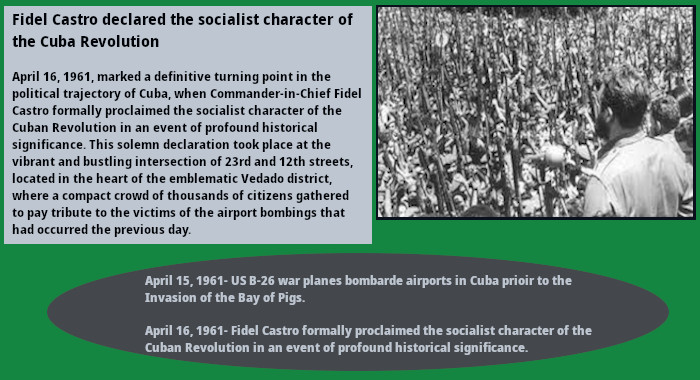
April 16, 1961, marked a definitive turning point in the political trajectory of Cuba, when Commander-in-Chief Fidel Castro formally proclaimed the socialist character of the Cuban Revolution in an event of profound historical significance. This solemn declaration took place at the vibrant and bustling intersection of 23rd and 12th streets, located in the heart of the emblematic Vedado district, where a compact crowd of thousands of citizens gathered to pay tribute to the victims of the airport bombings that had occurred the previous day.
Set against an atmosphere charged with patriotic fervor and resolute determination, Castro framed the revolutionary process as a struggle of the humble, by the humble, and for the humble. In doing so, he established a new ideological paradigm that boldly challenged regional dominance and existing power structures. Far from being an isolated statement, this proclamation served as a direct and audacious response to escalating diplomatic tensions with the United States government and the persistent attempts at external destabilization.
The speech functioned as both an ideological preamble and a moral mobilization necessary to confront the imminent Bay of Pigs invasion, which would unfold mere hours later on April 17. Castro’s declaration consolidated the unity of the Cuban people under a renewed political identity in the face of the looming threat of foreign military intervention. By choosing this critical moment to declare socialism, he transformed the defense of national sovereignty into an international class struggle, forever altering the geopolitical balance of the Western Hemisphere during the Cold War.
The context surrounding this historic announcement was one of acute crisis and heightened confrontation. The bombings of March 15 targeted Cuban airports, aiming to debilitate the nation’s air capabilities and destabilize the revolutionary government. These attacks were widely believed to have been orchestrated by exiled Cuban dissidents supported by covert operations from the United States Central Intelligence Agency. In response, the Cuban leadership intensified its rhetoric and concrete measures toward solidifying the revolution’s ideological foundation and popular support.
Fidel Castro’s articulation of socialism as the defining characteristic of the revolution stemmed from a confluence of internal social dynamics and external geopolitical pressures. Internally, the revolution sought to redress centuries of inequality and oppression suffered by Cuba’s working classes, peasants, and marginalized communities. The promise of social justice, land reform, educational expansion, and healthcare access resonated deeply within the nation, fostering widespread enthusiasm and loyalty.
Externally, the United States’ aggressive posture toward Cuba manifested through economic embargoes, diplomatic isolation, and clandestine plots aimed at regime change. The proclamation of socialism was therefore not only a declaration of ideological intent but also a strategic maneuver designed to consolidate national resolve, attract international socialist and communist solidarity, and frame the Cuban struggle within the broader contest between capitalist and socialist blocs.
Moreover, the speech underscored the intrinsic linkage between social revolution and national sovereignty. Castro’s emphasis on the “humble” as both agents and beneficiaries of the revolution highlighted a departure from traditional elite-dominated politics, affirming a vision of popular empowerment and participatory governance. This redefinition of revolutionary legitimacy infused the Cuban project with an enduring ethos of egalitarianism and anti-imperialism.
The immediate aftermath of the April 16 speech saw the Cuban populace galvanized in anticipation of the impending invasion. When the Bay of Pigs operation commenced on April 17, the unity and preparedness of the Cuban forces and citizenry proved decisive in repelling the assault. This victory reinforced the socialist commitment articulated by Castro and emboldened the leadership’s confidence in pursuing transformative policies despite external hostilities.
Internationally, the declaration reverberated throughout Latin America and beyond, inspiring leftist movements and alarming conservative governments aligned with the United States. The Cuban Revolution thus emerged as a symbol of resistance and a catalyst for ideological polarization during the Cold War era. The United States government amplified its efforts to contain and undermine the Cuban model, setting the stage for decades of geopolitical rivalry and proxy confrontations.
In conclusion, Fidel Castro’s proclamation on April 16, 1961, was a seminal moment that transcended mere political rhetoric. It signified the crystallization of a revolutionary ethos that integrated social justice, national sovereignty, and international solidarity under the banner of socialism. The timing, on the eve of a foreign military invasion, underscored the inseparability of Cuba’s internal transformation from its external struggles. This declaration irrevocably reshaped the course of Cuban history and altered the global geopolitical landscape, leaving an indelible legacy that continues to be studied and debated to this day.