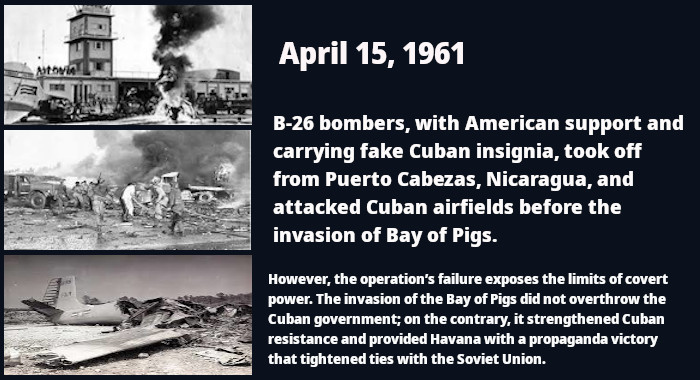
In April 1961, a brief phrase in Spanish captures a moment that still resonates in regional memory: B-26 bombers, with American support and carrying fake Cuban insignia, took off from Puerto Cabezas, Nicaragua, and attacked Cuban airfields before the invasion of Bay of Pigs. This concise account goes beyond a simple record of military maneuvers; it frames a campaign of deception, projection and international complicity that transformed the politics of the Cold War in the hemisphere.
The detail of the fake badges goes beyond mere theatrics. Hiding the identity of the attacking aircraft sought to generate denial and present the attacks as internal, not foreign actions. This tactic reveals the political logic of the operation: to hide America’s open involvement, influence world public opinion, and provide a pretext for a broader military campaign. It also shows how the mechanics of war go beyond bombs and bullets, encompassing visual symbols and narrative control.
The choice of Puerto Cabezas as a starting point highlights how the conflict spread to third-party territories. Nicaragua’s role, whether voluntary or forced, reminds us that regional actors have often become the scene of superpower disputes. The attacks on Ciudad Libertad, Santiago de los Baños and Santiago de Cuba were not isolated incidents, but a coordinated effort to weaken Cuban air defenses and pave the way for the subsequent amphibious assault. Attacking airfields first is a classic tactic: without air cover, defenders lose mobility, supply lines, and morale.
However, the operation’s failure exposes the limits of covert power. The invasion of the Bay of Pigs did not overthrow the Cuban government; on the contrary, it strengthened Cuban resistance and provided Havana with a propaganda victory that tightened ties with the Soviet Union. Far from the rapid decapitation of Castro’s government, the episode amplified Cold War tensions and deepened domestic Cuban resolve.
This episode also calls for reflection on responsibility. Masking military actions behind false emblems and staging attacks from foreign territory raises legal and ethical questions that resonate today: about sovereignty, the use of intervening agents, and the thin line separating covert action from direct aggression. For the US, the issue became an international embarrassment and a lesson about the risks of plausible denial. For Cuba, it became evidence of a hostile hemisphere that justified stricter security measures and consolidation of power.
Historical accounts often reduce these events to mere strategic checklists – bombed airfields, amphibious landings – but the human consequences were immediate: disrupted lives, damaged infrastructure, and a legacy of mistrust. Communities near the attacked airports faced the terror of sudden violence; families suffered the physical and political consequences for years.
A brief historical episode, like the above, reveals deeper truths about power and perception. The use of forged badges and foreign bases were tactical decisions with strategic objectives, but their final impact was political and moral, shaping regional alliances and public attitudes. The Bay of Pigs era remains an example of how covert operations can be counterproductive, how symbolism can be as important as weaponry, and how interventions that seek to conceal their involvement can leave wounds that last long after the aircraft have landed.