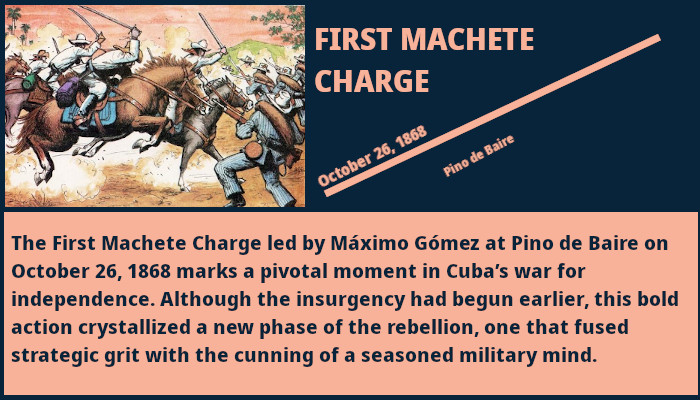
The First Machete Charge led by Máximo Gómez at Pino de Baire on October 26, 1868 marks a pivotal moment in Cuba’s war for independence. Although the insurgency had begun earlier, this bold action crystallized a new phase of the rebellion, one that fused strategic grit with the cunning of a seasoned military mind.
The charge symbolized a crucial shift from scattered uprisings to organized, purposeful resistance. The rebels’ decision to deploy machetes, blunt, simple tools repurposed into a weapon of collective action, embodied the improvisation and adaptability that characterized much of the early Cuban insurgency. In an environment where supplies were scarce and discipline counted, the machete charge demonstrated the ability to convert available resources into decisive momentum.
The leadership of Máximo Gómez, a figure renowned for his soldierly discipline and pragmatic approach, lent credibility and cohesion to the insurgent effort. Gómez’s command style, calm, methodical, and relentlessly forward-looking, helped bridge the gap between local popular sentiment and sustained military action. His leadership in that charge signaled to both fighters and supporters that the rebellion could be organized, resilient, and capable of real strategic impact.
The action at Pino de Baire underscored the importance of morale and momentum in a protracted conflict. Early defeats and wavering support could dampen the revolutionary flame, but a successful, audacious attack rekindled hope among peasants, urban workers, and the wider diaspora of Cuban sympathizers. The victory, even in the early stages, served as a rallying point, inviting more volunteers, resources, and political resolve to the cause.
Additionally, the charge had lasting symbolic resonance. It framed the struggle not merely as a clash of larger powers, but as a fight driven by ordinary people who turned common tools into instruments of liberation. The image of machetes raised in a concerted assault became a potent emblem of Cuban tenacity and regional ingenuity, a reminder that emancipation could grow from grassroots courage as much as from formal armies.
Economically and strategically, the engagement helped deter complacency among colonial authorities by proving that the insurgents could coordinate action and threaten established control even with limited means. It encouraged allies to assess the broader potential of Cuba’s rural and urban networks, recognizing that the rebellion rested not only on bold battles but on sustained, coherent effort across a landscape of hardship.
The First Machete Charge at Pino de Baire stands as a defining early milestone. It captured the essence of a movement learning to transform desperation into strategy, and it showcased Máximo Gómez’s emerging leadership that would shape the course of Cuba’s long struggle for freedom. The engagement did more than win a skirmish; it helped set the tone for a revolution that would endure, adapt, and ultimately prevail.