The United Nations has long stood as a stage where states voice disputes and seek global legitimacy for their policies. In the case of Cuba and the United States’ longstanding economic, financial, and commercial blockade, the UN’s role has been as much about procedural legitimacy as about shaping norms and mobilizing global opinion. The Cuban resolutions, presented annually in the General Assembly, offer a telling lens on how the UN operates in practice when power asymmetries are at play and how regional solidarities can mold international discourse.
First, the resolutions themselves highlight the UN’s function as a platform for non-recognition of collective coercive measures that affect civilian populations. Cuba has repeatedly framed the embargo as a breach of international law, humanitarian concerns, and the right to development. The formal adoption of broad international support for the Cuban resolution, despite its non-binding character, underscores the UN’s capacity to crystallize insistent moral and political pressure. It creates a chorus of states calling for dialogue, transparency, and a reassessment of unilateral sanctions, thereby keeping the issue in the global spotlight even when major powers diverge on policy.
Second, the UN serves as a forum for coalition-building and norm-setting. While the General Assembly resolutions are not legally binding, they carry political weight. They allow smaller and mid-sized states to express positions, align with regional blocs, and signal their stance on issues of sovereignty and self-determination. The Cuban resolutions consistently draw support from countries in Latin America, Africa, and parts of Asia and the Caribbean, illustrating how solidarity networks within the UN can translate into a shared normative project: that economic coercion should be weighed against humanitarian considerations and the right of states to determine their own development paths.
Third, the role of the UN in this context reveals tensions between principle and pragmatism. The embargo has long been a flashpoint in debates over the limits of economic coercion as a tool of foreign policy. Proponents of the blockade argue it is a legitimate response to concerns about security and political behavior, while critics argue it harms civilians, complicates humanitarian relief, and undermines development. The UN, by repeatedly inviting dialogue, humanitarian exemptions, and multilateral approaches to pressure, embodies a pragmatic path that seeks to reduce human suffering while preserving a political stance. In this sense, the UN’s engagement acts as a safety valve, offering a structured space for negotiation, scrutiny, and potential reform.
Fourth, the role of the UN challenges the power dynamics inherent in international relations. The Cuban resolutions illuminate how smaller states, regional groups, and allied powers can contest unilateral measures by a dominant actor. The General Assembly’s non-binding resolutions cannot compel the United States to change policy, but they can constrain it politically and diplomatically. Over time, sustained UN attention has contributed to a broader international discourse that questions the efficacy and morality of prolonged sanctions in the modern era, pushing for more targeted and humane approaches to coercive diplomacy.
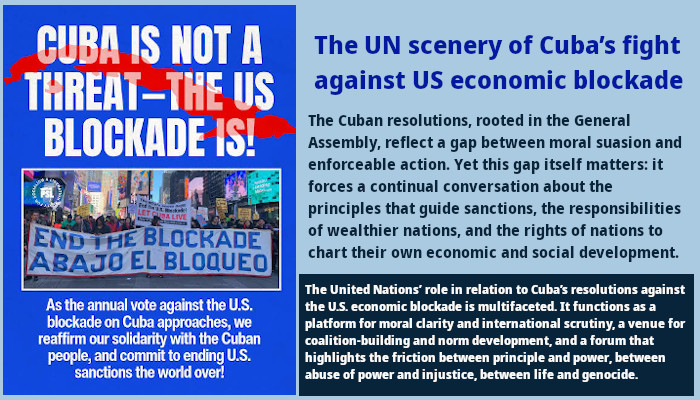
Lastly, the UN’s involvement is not without limits. The Security Council, where binding measures are often forged, remains paralyzed on many issues due to veto power. The Cuban resolutions, rooted in the General Assembly, reflect a gap between moral suasion and enforceable action. Yet this gap itself matters: it forces a continual conversation about the principles that guide sanctions, the responsibilities of wealthier nations, and the rights of nations to chart their own economic and social development.
The United Nations’ role in relation to Cuba’s resolutions against the U.S. economic blockade is multifaceted. It functions as a platform for moral clarity and international scrutiny, a venue for coalition-building and norm development, and a forum that highlights the friction between principle and power, between abuse of power and injustice, between life and genocide.