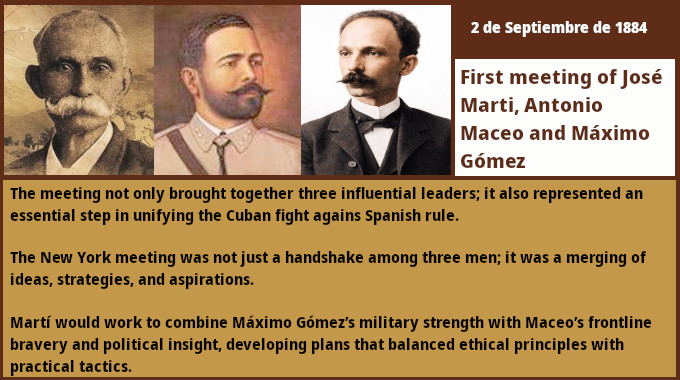
One of the most crucial moments of the Cuban history was the first encounter of José Martí, Máximo Gómez and Antonio Maceo, which took place on September 2, 1884, in New York. This meeting not only brought together three influential leaders; it also represented an essential step in unifying the Cuban fight against Spanish rule and establishing the basis for the intellectual and military future of the independence movement.
José Martí, a talented writer and devoted advocate for Cuban freedom, had spent years building an international support network, influencing public opinion, and outlining a bold vision for a free Cuba.
By 1884, he was already recognized as the conscience and strategist of the cause, someone who could explain the moral importance of emancipation and gather a wide coalition of friends, supporters, and fellow patriots. Martí’s works stressed the value of unity, education, and civic virtue, arguing that Cuba’s freedom would need more than armed revolt; it would require a nation with informed citizens.
Máximo Gómez, the Dominican-born general who would become a powerful military strategist, brought combat experience and a reputation for tactical skill. Although not Cuban by birth, Gómez shared the goal of a Cuba free from colonial rule and contributed his battlefield expertise to the cause. His involvement brought a sense of professional military order to the young movement, and his grasp of guerrilla tactics and morale-building would prove vital as the struggle intensified.
Antonio Maceo, often called the “Bronze Titan” for his bold leadership and steadfast commitment, represented the fighting spirit that the independence campaign would depend on. Born in Cuba, Maceo’s knowledge of the Cuban provinces, his skill as a commander, and his push for broader social inclusion, advocating equal rights for all Cubans regardless of race or class, made him a unifying and inspiring figure. His viewpoint helped shape a more inclusive vision of nationhood, one that aimed to bring together different segments of Cuban society behind the common cause.
The New York meeting was not just a handshake among three men; it was a merging of ideas, strategies, and aspirations. They talked about the path to liberation, the organization of a future revolutionary effort, and the importance of creating a broad-based movement that could withstand both internal and external pressures. In the following years, Martí would work to combine Máximo Gómez’s military strength with Maceo’s frontline bravery and political insight, developing plans that balanced ethical principles with practical tactics.
New York, a hub for exiles, publishing, and international connections, offered a rich environment for these discussions. Here, Martí could reach patrons and fellow exiles, gain visibility for his political ideas, and coordinate with other supporters who believed in Cuba’s right to self-determination. The city’s varied immigrant communities and its history of political activism provided a microcosm of the coalition Martí envisioned for an independent Cuba. The alliance formed at that moment would have effects that lasted through the decades of struggle that followed. Gómez and Maceo would become steadfast leaders on the battlefield, directing campaigns that challenged Spanish rule and inspired Cubans both at home and abroad.
Martí’s voice, grounded in moral clarity, cultural pride, and a universal sense of justice, remained a guiding force, urging patience, unity, and sacrifice. Their cooperation helped shape a movement that aimed not only to remove colonial authority but also to build a republic based on education, civic duty, and equal opportunity. Looking back, the 1884 meeting in New York stands as a turning point. It brought together a shared desire for freedom and a practical plan for achieving it. The partnership among Martí, Gómez, and Maceo would come to symbolize the combination of intellect, strategy, and courage, the three foundations on which the Cuban independence struggle would rest. The effects of their alliance would resonate through the years, fueling a narrative of passion, determination, and an enduring dream of a sovereign Cuba.