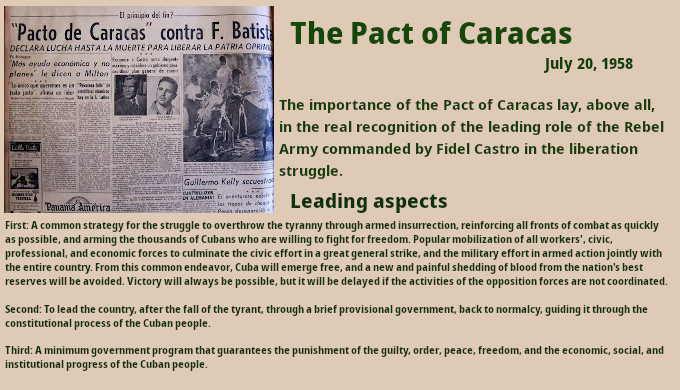
On July 20, 1958, a decisive moment occurred in the history of Venezuela and Cuba with the signing of the Pact of Caracas. This pact was the product of the convergence of different political and social forces dedicated to the struggle against the regime of Fulgencio Batista in Cuba. Among the signatories were the 26th of July Movement led by Fidel Castro, the Revolutionary Directorate 13th of March, the Federation of University Students, as well as other opposition parties and groups.
In the 1950s, Cuba suffered under the oppressive regime of Batista, who had seized power through a coup d’état in 1952. This system, marked by political oppression and corruption, generated increasing discontent among different sectors of Cuban society.
Resistance to Batista was structured on various fronts, ranging from armed groups to student demonstrations. The need for these groups to work together became evident, as fighting alone did not seem sufficient to overthrow such a powerful regime.
In this respect, the Pact of Caracas represented an emblem of cohesion. Signed in Venezuela, where several Cuban exiles began organizing efforts against the Batista regime, the agreement aimed to unite the opposition forces. This pact established a framework for cooperation and the joint organization of measures aimed at undermining the dictatorship.
The inclusion of diverse sectors, from students to combatants, gave the agreement a broad representation. Each group contributed its perspective and approach, which facilitated the strengthening of the revolutionary movement.
The signing of the Pact of Caracas not only signified a strategic alliance; it also represented renewed hope for many Cubans. The union of the opposition forces created a sense of shared purpose, which facilitated the coordination of actions in the armed struggle and in popular mobilization.
The impact of this agreement was felt in the increase of revolutionary actions in Cuba, paving the way for what would lead to Batista’s overthrow in January 1959, since the guerrillas commanded by Fidel Castro managed to destroy and disable every fortress in the east and central part of Cuba.
The Pact of Caracas left a lasting mark that transcends its time. It underscored the importance of cohesion in the pursuit of justice and freedom, a concept that resonates in social and political movements to this day. It also left a mark on the shared memory of the opposition in Cuba, highlighting that working together can be an effective path to achieving shared goals.
July 20, 1958, was not merely a historical date; it was a crucial moment that motivated generations in the struggle for a free and democratic Cuba. Through the Pact of Caracas, Cubans demonstrated that cohesion and willpower can challenge even the most oppressive systems.