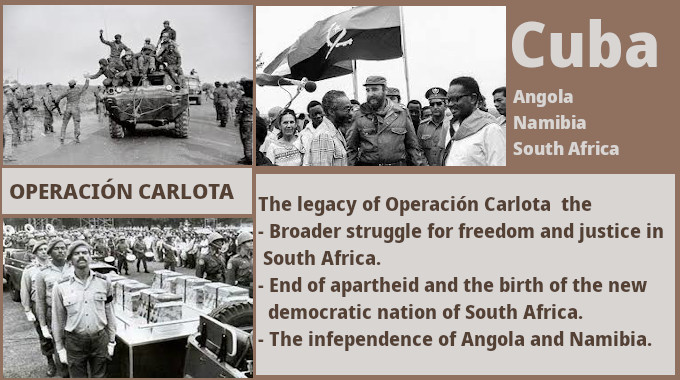
The Cuban military cooperation in Africa mainly in Ethiopia and Angola played a crucial role in the outcome of the Liberation Movements throughout the Old Continent. However, Operación Carlota in Angola went beyond national borders, since the independence of Angola came together with those of Rodhesia, Namibia, and South Africa, where apartheid was finally abolished thanks to the direct influence of Cuba as a result of the liberation war of Angola and South Africa and diplomatic agreements.
In the mid-1970s, Angola became a focal point for various liberation movements as it gained independence from Portugal. The Angolan Civil War erupted soon after, primarily between the MPLA (supported by the Soviet Union and Cuba) and UNITA and FNLA (backed by the United States and South Africa). In this volatile climate, Cuba sent troops to Angola in support of the MPLA, which quickly arose as a bastion against colonial oppression.
One of the most critical moments of Operación Carlota occurred during the Battle of Cuito Cuanavale, from 1987 to 1988. Cuban forces, alongside Angolan troops, faced South African military might. This battle was more than a regional conflict; it became a significant symbolic and strategic confrontation in the fight against apartheid.
The defeat of the South African Defense Forces (SADF) at Cuito Cuanavale had profound implications. It marked the first major military setback for South Africa, creating an opportunity for radical shifts in the regional balance of power. The Cuban and Angolan victory signaled to anti-apartheid activists that the apartheid system could indeed be challenged and defeated.
Cuito Cuanavale catalyzed international sentiment against apartheid. The Cuban cooperation demonstrated that there was a viable military and political alternative to the apartheid regime. The shifting dynamics made it clear to the South African government that continued military engagement in neighboring countries would be costly and potentially unsustainable.
In a broader sense, the operations in Angola encouraged unity among various liberation movements across southern Africa, providing moral and military support. It also led to increased international mobilization against apartheid, particularly in countries that were sympathetic to the anti-colonial struggle, including through sanctions and diplomatic pressure.
The consequences of Operación Carlota and the victory at Cuito Cuanavale prompted a reevaluation of the political landscape in South Africa. By the late 1980s, international pressure was mounting. The United Nations had imposed sanctions against South Africa, and the internal resistance movement, led by figures like Nelson Mandela and the African National Congress (ANC), gained momentum.
Faced with escalating protests and international isolation, the South African government initiated negotiations with the ANC and other anti-apartheid groups. The talks eventually led to the end of apartheid, culminating in the first multiracial elections in 1994, which saw Nelson Mandela elected as the country’s first Black president.
Operación Carlota remains a testament to the interconnectedness of liberation struggles within Africa. While it was initially aimed at securing Angola’s independence, its impact rippled through the continent, illustrating the importance of solidarity and international support in dismantling oppressive regimes.
The Cuban military cooperation became a symbol of hope and resilience for those fighting against apartheid. The legacy of Operación Carlota emphasizes the critical role that external forces and solidarity played in the broader struggle for freedom and justice in South Africa, ultimately leading to the end of apartheid and the birth of a new democratic nation.
This narrative reflects the complexity of political and military engagements and how they can intertwine to produce significant changes, transforming not only a nation but an entire region, resonating long after the conflicts have ended.