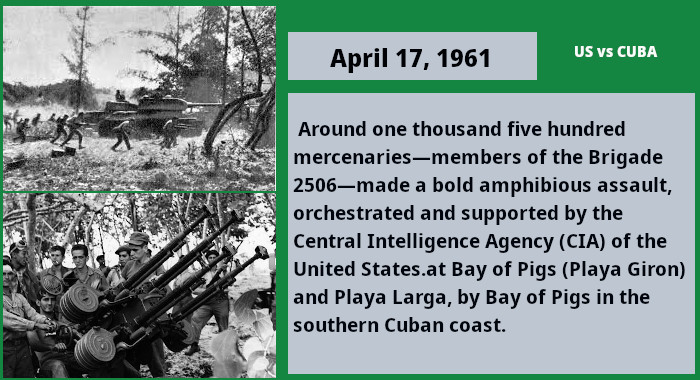
In the early months of 1961, the geopolitical landscape of the Americas was marked by intense tensions and covert operations, emblematic of the broader Cold War struggle between the United States and the Soviet Union. Against this backdrop, a significant and daring endeavor unfolded on the southeastern coast of Cuba, near the Zapata Peninsula. It was here, at Bay of Pigs (Playa Giron) and Playa Larga, that approximately one thousand five hundred mercenaries—members of the Brigade 2506—made a bold amphibious assault, orchestrated and supported by the Central Intelligence Agency (CIA) of the United States.
The origins of this operation trace back to the complex policy objectives of the U.S. government, which sought to curb the spread of communism in the Western Hemisphere following the Cuban Revolution of 1959. After Fidel Castro’s revolutionary forces overthrew the regime of Fulgencio Batista, Cuba swiftly aligned itself with the Soviet Union, igniting fears within Washington of a communist foothold a mere ninety miles from its shores. These anxieties prompted the formulation of a plan to remove Castro from power through covert means, utilizing exiled Cuban opponents trained and equipped abroad.
Central to this strategy was the creation and training of an amphibious assault brigade known as Brigade 2506. The cadre consisted predominantly of Cuban exiles who harbored vehement opposition to Castro’s socialist government and were willing to risk their lives in an attempt to restore what they perceived as freedom and democracy to their homeland. The training facility was established discreetly in Guatemala, a nation under the authoritarian rule of the Somoza family, which maintained close ties with the United States. Guatemalan territory provided a strategic and somewhat remote location for preparing the brigade in guerrilla warfare, amphibious landings, and sabotage operations.
On the night preceding the invasion, Brigade 2506 embarked from a Nicaraguan port controlled by the Somoza regime. This choice of departure point was not incidental; Nicaragua’s authoritarian government, likewise aligned with U.S. interests, facilitated the logistical preparations necessary for the mission. The brigade’s vessels sailed under the cover of darkness toward the southwestern coastline of Cuba, targeting the sparsely populated yet strategically valuable beaches of Playa Girón and Playa Larga on the Zapata Peninsula. The plan envisioned a swift landing followed by rapid territorial gains inland, catalyzing a popular uprising against Castro’s forces.
However, the reality that awaited the mercenaries was far harsher than anticipated. Cuban revolutionary forces, forewarned and well-prepared, mounted a robust defense. The invading brigade encountered strong resistance from the Cuban army and militia, whose familiarity with the local terrain and high morale rendered the assault increasingly untenable. Moreover, the anticipated mass insurrection among the Cuban populace failed to materialize; instead, many locals viewed the invaders as foreign aggressors, consolidating support for Castro’s government.
Over several days of fierce combat, the mercenaries suffered heavy casualties and dwindled in strength. Their supply lines were compromised, and attempts to secure air and naval support proved insufficient or nonexistent. The operation culminated in a decisive defeat, with most of the invaders either killed, captured, or forced into retreat. The Cuban government publicly displayed hundreds of prisoners, turning the failed incursion into a propaganda victory that bolstered national unity and Castro’s legitimacy.
This ill-fated endeavor, now universally known as the Bay of Pigs Invasion, resonated far beyond the immediate military confrontation. It exposed the limitations of covert action and the complexities of interventionist policies during the Cold War era. For the United States, the operation became an international embarrassment, prompting introspection within the Kennedy administration regarding foreign policy and intelligence operations. For Cuba, it galvanized resistance and deepened its alliance with the Soviet Union, setting the stage for further confrontations in the region.
In conclusion, the landing of the amphibious assault brigade at Playa Girón and Playa Larga in 1961 constituted a pivotal episode in Cold War history. The involvement of approximately 1,500 mercenaries trained and armed by the CIA, departing clandestinely from Nicaragua, illustrates the intricate web of international alliances and hostilities characteristic of the time. The ultimate failure of the invasion underscores the profound challenges inherent in attempting to reshape the political landscape of sovereign nations through military intervention, especially when such efforts lack widespread domestic support and underestimate the resolve of indigenous populations.