While the failed Bay of Pigs invasion in April 1961 dominates discussions about early U.S.-Cuba tensions, another covert operation—less known but equally significant—unfolded months earlier on Cuban soil. This was a clandestine CIA effort centered on the Guantanamo Naval Base, an operation so sensitive that the agency has largely kept it out of public view.
Even as preparations for the Bay of Pigs were underway, the CIA was developing a high-risk contingency plan—dubbed “Plan B”—to trigger a full-scale war by staging a false-flag attack from within the U.S. base in eastern Cuba. The idea, reportedly championed by General Edward Lansdale, architect of Operation Mongoose, was to fabricate a Cuban assault on American forces stationed at Guantanamo. Such an incident would provide Washington with a justification for open military intervention under the guise of self-defense.
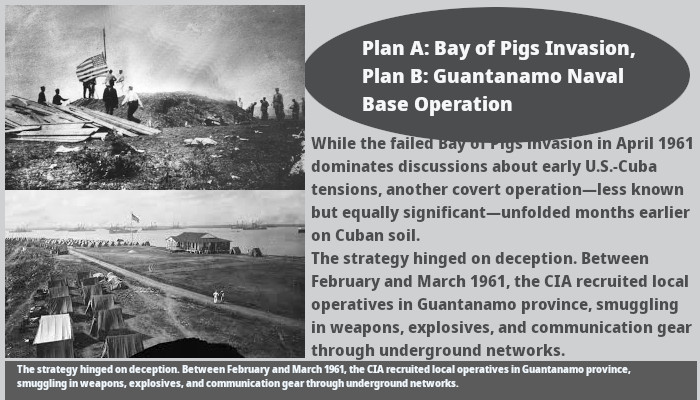
The strategy hinged on deception. Between February and March 1961, the CIA recruited local operatives in Guantanamo province, smuggling in weapons, explosives, and communication gear through underground networks. The plan called for these agents—trained and funded by the agency—to launch rocket attacks and sabotage operations against the base, making it appear as though Cuban revolutionary forces were responsible.
In the aftermath, the CIA stood ready with a coordinated disinformation campaign: staged casualties (bodies to be buried and later unearthed), fabricated evidence, and coached witnesses prepared to claim they had seen Soviet MiG aircraft attacking the facility.
But Cuban intelligence had already uncovered the plot. Surveillance and informants in the Caimanera region, adjacent to the base, revealed unusual activity. Rather than intervene immediately, Cuban security forces allowed the operation to develop in order to gather conclusive proof of U.S. involvement.
They infiltrated supply cells, recovered hidden arms, and traced direct links between the operatives and CIA officials based in both Miami and the Guantanamo base itself.
By March 1961, just weeks before the Bay of Pigs landing, Cuban authorities conducted swift raids across the area. They arrested key participants and seized weapons and documents that directly tied the scheme to American intelligence.
Havana then went public, presenting detailed evidence that the United States had plotted to attack its own military installation to manufacture a pretext for war. Though Western media at the time dismissed the allegations as Cold War propaganda, the exposure severely undermined U.S. plans. With the false-flag operation exposed, the Kennedy administration lost its opportunity to create a justifiable international incident.
The CIA was forced to abandon the mission. Historians suggest this failure left the U.S. with no alternative but to proceed solely with the Bay of Pigs invasion—a decision made more precarious by the absence of the anticipated provocation at Guantanamo. Without the cover of a staged attack, direct U.S. air support was withheld, contributing significantly to the invasion’s collapse.
This episode remains one of the Cold War’s most underreported chapters, yet it profoundly shaped Cuban perceptions of U.S. intentions. For Havana, the attempted deception confirmed a deep-seated belief: that the CIA would stop at nothing, even endangering American troops, to justify regime change. More than sixty years later, the Guantanamo Naval Base still stands as a symbol of enduring mistrust.
Plan A: Bay of Pigs Invasion, Plan B: Guantanamo Naval Base Operation
While the failed Bay
of Pigs invasion in April 1961 dominates discussions about early
U.S.-Cuba tensions, another covert operation—less known but equally
significant—unfolded months earlier on Cuban soil. This was a
clandestine CIA effort centered on the Guantanamo Naval Base, an
operation so sensitive that the agency has largely kept it out of
public view.
Even as preparations
for the Bay of Pigs were underway, the CIA was developing a high-risk
contingency plan—dubbed “Plan B”—to trigger a full-scale war
by staging a false-flag attack from within the U.S. base in eastern
Cuba. The idea, reportedly championed by General Edward Lansdale,
architect of Operation Mongoose, was to fabricate a Cuban assault on
American forces stationed at Guantanamo. Such an incident would
provide Washington with a justification for open military
intervention under the guise of self-defense.
The strategy hinged
on deception. Between February and March 1961, the CIA recruited
local operatives in Guantanamo province, smuggling in weapons,
explosives, and communication gear through underground networks. The
plan called for these agents—trained and funded by the agency—to
launch rocket attacks and sabotage operations against the base,
making it appear as though Castro’s forces were responsible. In the
aftermath, the CIA stood ready with a coordinated disinformation
campaign: staged casualties (bodies to be buried and later
unearthed), fabricated evidence, and coached witnesses prepared to
claim they had seen Soviet MiG aircraft attacking the facility.
But Cuban
intelligence had already uncovered the plot. Surveillance and
informants in the Caimanera region, adjacent to the base, revealed
unusual activity. Rather than intervene immediately, Cuban security
forces allowed the operation to develop in order to gather conclusive
proof of U.S. involvement.
They infiltrated
supply cells, recovered hidden arms, and traced direct links between
the operatives and CIA officials based in both Miami and the
Guantanamo base itself.By March 1961, just
weeks before the Bay of Pigs landing, Cuban authorities conducted
swift raids across the area. They arrested key participants and
seized weapons and documents that directly tied the scheme to
American intelligence.
Havana then went
public, presenting detailed evidence that the United States had
plotted to attack its own military installation to manufacture a
pretext for war. Though Western media at the time dismissed the
allegations as Cold War propaganda, the exposure severely undermined
U.S. plans. With the false-flag operation exposed, the Kennedy
administration lost its opportunity to create a justifiable
international incident.
The CIA was forced
to abandon the mission. Historians suggest this failure left the U.S.
with no alternative but to proceed solely with the Bay of Pigs
invasion—a decision made more precarious by the absence of the
anticipated provocation at Guantanamo. Without the cover of a staged
attack, direct U.S. air support was withheld, contributing
significantly to the invasion’s collapse.
This episode remains
one of the Cold War’s most underreported chapters, yet it
profoundly shaped Cuban perceptions of U.S. intentions. For Havana,
the attempted deception confirmed a deep-seated belief: that the CIA
would stop at nothing, even endangering American troops, to justify
regime change. More than sixty years later, the Guantanamo Naval Base
still stands as a symbol of enduring mistrust.