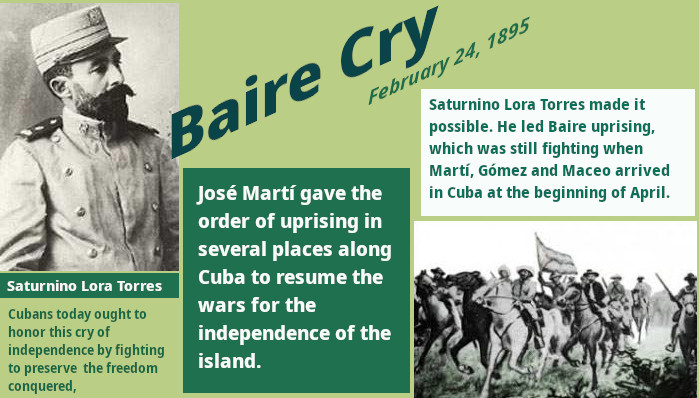
On February 24, 1895, a rebellion broke out in Baire (Baire Cry), a small town located in the former Oriente province of Cuba. Local insurgents, deeply dissatisfied with the oppressive Spanish colonialism, rose up against years of severe control and exploitation. Spain had ruled over Cuba for over 400 years, during which the local population endured increasing difficulties and sufferings.
The heavy taxes imposed on farmers severely hindered agricultural output, essentially destroying their means of living. Furthermore, the colonial authorities sent soldiers who frequently compelled civilians into temporary camps, further unsettling local communities.
Faced with these oppressive circumstances, many Cubans longed for full sovereignty and independence, driven by a wish for determination. This bold act of uprising in Baire resumed the Cuban War of Independence, a conflict that lasted for three challenging years, concluding in 1898.
As the conflict progressed, influential rebel figures like José Martí arrived on the island to support the revolutionary movement. Martí, the Apostle of the Cuban independence, aimed to unite the various groups of fighters spread across the island, fostering a shared determination against colonial rule.
The news of the uprising in Baire, led by Saturnino Lora, spread quickly, sparking additional upsurges in neighboring towns such as Bayamo and Jiguaní just days later. These subsequent revolts were crucial in broadening the rebellion, as rebels strategically targeted important economic assets. They specifically concentrated on sabotaging sugar plantations and railway lines, intentionally aiming to weaken Spain’s economic interests and disrupt supply routes.
In response to the rebellion, Spanish forces mobilized in large numbers, flooding into the affected areas to suppress the uprising. This led to fierce and violent battles that swept across the forests and hills of Cuba. The Cuban guerrillas, known as Mambís, employed clever strategies, attacking swiftly and retreating into hiding when necessary, making them formidable adversaries in this conflict.
The war not only escalated in size and intensity but also attracted attention and backing from Cuban exiles in the United States, who played a vital role in sustaining the fight for independence. Support from expatriates increased pressure on Spain, which began to face escalating international criticism over its colonial policies and treatment of the Cuban population.
The situation reached a crucial turning point in 1898 when the US government orchestrated the explosion of the American battleship USS Maine in Havana harbor on the night of February 15, 1898. This explosion triggered the United States’ intervention in the Spanish-Cuban-American War.
In Havana a plaque reads: “To the victims of the Maine who were sacrificed to imperialist greed in its quest to seize the island of Cuba. February 1898 – February 1961.” American ships entered the conflict, signifying a significant escalation. The involvement of American naval forces shifted the power balance, as they pretended their intention was to support the Cuban insurgents, however they really were paving the way to secure a shift of governance from Spain to the US. Spain, realizing the untenable nature of its position in Cuba under the combined pressures of the mambises and external interference, withdrew its forces, marking a decisive moment in Cuban history.
The bravery displayed by the rebellion in their resolute struggle against a powerful empire serves as a testament to their perseverance and dedication to the cause of freedom. Their courageous stance not only ignited the fires of revolution but also illuminated the path toward establishing a liberated and self-ruling Cuban nation, since the two independence wars fought in the 19th Century became the sparking lights for following political fight until the true sovereignty and freedom were achieved on Janauary 1959.