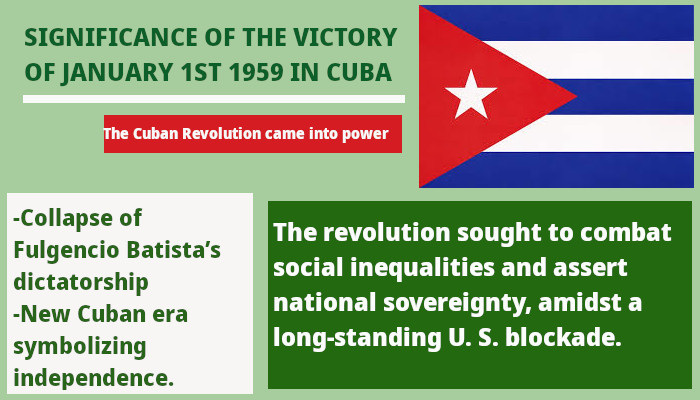
Fidel Castro’s victory on January 1, 1959 marked the definitive collapse of Fulgencio Batista’s dictatorship and the birth of a new Cuban era, symbolizing independence, social justice, and the promise of radical transformation.
On the dawn of the new year, Fulgencio Batista fled Cuba, leaving behind a crumbling regime that had been sustained by corruption, repression, and close ties to U.S. economic interests. Into this vacuum stepped Fidel Castro and the 26th of July Movement, whose guerrilla campaign had captured the imagination of the Cuban people.
In Santiago de Cuba, Castro announced the victory from the balcony of the Headquarters, declaring that Cuba had finally achieved its long-sought independence. The guerrilla columns led by Camilo Cienfuegos and Che Guevara advanced toward Havana, securing key military strongholds like Yaguajay and Santa Clara, ensuring the revolution’s momentum could not be reversed.
Thus, on January 1, 1959, the Cuban revolutionary government was established, initiating the dismantling of the neocolonial political system. Subsequently, the first constitutional reforms were enacted, such as the Agrarian Reform Law of May 17, which abolished the large landlord system and nationalized the lands that had previously belonged to private landowners, distributing them to peasants.
Likewise, the new Cuban government nationalized all U.S.-owned properties on the island and canceled the sugar quotas that had granted the United States a sugar monopoly in the Caribbean and the Americas. From that moment until the present day, arguing that Cuba had adopted the principles of communism and Soviet socialism in the Americas, the United States led and promoted a policy of harassment, denigration, and economic blockade against Cuba.
January 1, 1959, is a pivotal date for revolutionary movements worldwide, marking a moment when an organized people managed to break free from U.S. colonial control, even though the U.S. government continues its policy of blockade and denigration to this day. It is worth noting that in 2021, before the United Nations General Assembly, the only two countries that voted against ending the U.S. embargo on Cuba were Israel and the United States of America.
The establishment of Cuba’s revolutionary government drew attention to the ongoing human rights violations suffered by the Cuban people throughout the colonial period of their history. Since then, Cuba has dedicated a significant portion of its efforts and budget to eradicating illiteracy and hunger, as well as ensuring quality education for all its citizens. In 2011, UNICEF declared that Cuba was the only country in Latin America without child malnutrition, as well as being considered the only country in the world with sustainable development in the biennial Beijing report, presented by the global conservation organization WWF International.
The Cuban Revolution, which triumphed on January 1, 1959, initiated a significant transformation in Cuba aimed at fulfilling commitments to the people. One of the initial actions was the adoption of the Fundamental Law of the Republic on February 7, 1959, maintaining aspects of the previous constitution. This was followed by the establishment of the National Institute of Savings and Housing on February 17 to promote savings and address housing problems, leading to efforts to reduce private housing concentration, lower rents, and provide homeownership to many families.
In March, key measures included the takeover of the Cuban Telephone Company and the creation of the Cuban Institute of Cinematographic Art and Indupoor; many lacked basic services and education. The Comprehensive Educational Reform was approved on December 23 to begin creating a new education system. The Ministry of the Revolutionary Armed Forces was established to enhance military readiness against potential threats. The revolution sought to combat social inequalities and assert national sovereignty, amidst a long-standing U. S. blockade.
On May 17, Fidel Castro signed the agrarian reform law, redistributing land to dispossessed peasants and dismantling large landholdings, significantly impacting the upper class and foreign companies. This led many wealthy families and officials to flee to the United States.
Despite these changes, conditions for peasants remained poor; many lacked basic services and education. The Comprehensive Educational Reform was approved on December 23 to begin creating a new education system. On the other hand free health care was also established for all without any distinction.
Related article