The Automotive Transportation Services Business Group (GEA), comprised of 17 companies, has registered a 47.9% decrease in passenger transportation and a 31.5% decrease in freight transportation, as a consequence of fuel limitations stemming from the energy embargo imposed on Cuba by the U.S. government. Faced with this situation, the entity is promoting organizational changes, creating state-owned micro, small, and medium-sized enterprises (MSMEs), expanding ties with non-state actors, and incorporating electric vehicles to sustain its operations and improve services to the population.
During his appearance on the Round Table program, Oscar Alberto Carbajal Serrano, general director of the OSDE-GEA, explained how the 176 economic and social transformations approved by the National Assembly of People’s Power are being implemented in the sector and what the main alternatives are for addressing the current difficulties.
The executive described a particularly complex scenario for automotive transportation, with impacts affecting both passenger and freight services and having direct consequences on daily life.
One of the most significant examples is the National Bus Company. Already facing operational difficulties in 2025, the reduction in available fuel led to a considerable decrease in its services during 2026: from more than 5,000 passengers transported daily on interprovincial routes, the number fell to around 844.
The contraction also affects the distribution of goods, including medical supplies destined for hospitals and pharmacies, as well as products arriving in the country by sea and donations for photovoltaic parks.
According to Carbajal Serrano, freight transport has decreased by more than 31.5%, while passenger transport has contracted by 47.9%.
Among the most critical services, he mentioned multimodal transport, which requires more than 9,000 liters of fuel daily to guarantee its operations within the country.
These limitations have even impacted the transport of patients receiving hemodialysis treatment. In some areas, difficulties in ensuring transportation routes have forced the hospitalization of people requiring medical treatment, with the resulting impact on patients and their families.
Medicbús services, used by the National Bus Company, the Workers’ Transportation Company, and the School Transportation Company to transport people requiring specialized medical care, are also experiencing difficulties.
In the case of school transportation, the company is maintaining service for students in special education schools and their teachers, although it has been necessary to coordinate with the education sector to adjust the frequency of routes.
Other affected services include Taxi Cuba, combustion-powered tricycles, and vehicles used for local routes in various provinces. The group has more than 900 of these tricycles, primarily used for short trips, whose operation has also been limited by the fuel shortage. A Smaller Business Structure and New Management Styles
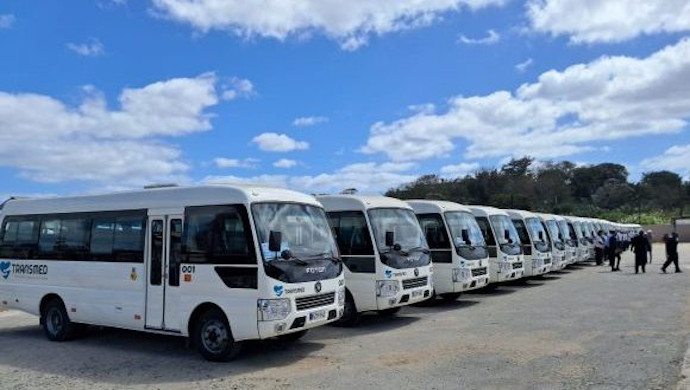
Transmed emerged to address the challenges faced by healthcare workers and the general public during their daily commutes to and from work. Photo: TRANSMED S.U.R.L.
Given this situation, the GEA (Group of Business Owners) began by studying the 176 approved transformations, organizing working groups, and conducting training seminars for its managers and employees. This process was extended to the 17 companies that comprise the organization, which operate in passenger and freight transportation, workshops, advertising, software, science, technology, and logistics.
One of the most significant changes involves the reorganization of the business management structure, following the enactment of Decree Law 120.
Carbajal Serrano explained that the former OSDE (Business Group) initially had 90 employees and later reduced that number to 70. The proposed structure for the new business group includes only 29 positions, a reduction intended to align the organization’s functions and size.
The changes also extend to the basic business units (UEBs), many of which will become state-owned micro, small, and medium-sized enterprises (MSMEs) or subsidiaries of the entities to which they belong.
The executive emphasized that the process is not limited to modifying administrative structures, but rather seeks to make better use of productive capacities and available resources.
As part of the new management approaches, Carbajal Serrano highlighted the creation of Transmed, a company designed to facilitate the mobility of healthcare personnel and patients requiring specialized treatments, which has plans to expand its operations.
(Source: cubadebate.cu)