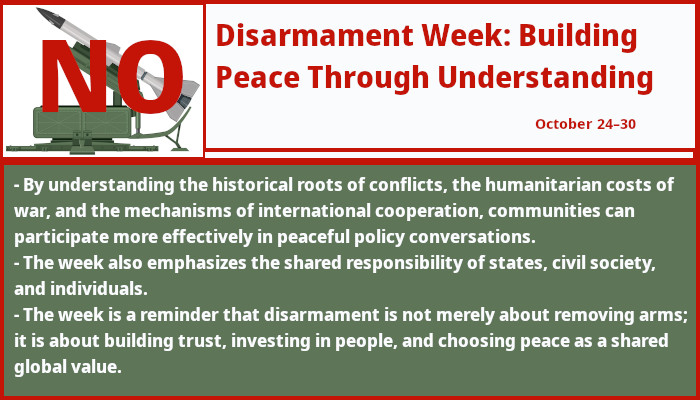
Every year, October 24–30 Disarmament Week is held, dedicated period to shed light on the complex issues surrounding weapons, security, and global peace. Though the topic can feel heavy, the goal is simple: promote knowledge and a deeper understanding of disarmament in its many forms and its cross-cutting impact on society.
At its core, disarmament is about reducing the sources of fear and violence. It involves not only the control and elimination of weapons but also the wider policies that influence how people live and interact on a daily basis. When nations work to limit arms, they are also opening space for diplomacy, development, and human rights to flourish.
Disarmament Week invites students, policymakers, professionals, and communities to explore questions such as how arms races affect budgets and priorities, how civilian protection can be improved, and how disarmament efforts intersect with issues like climate resilience and public health. Education plays a central role in this observance. Knowledge empowers people to demand transparency, accountability, and safer communities.
Public awareness campaigns, workshops, and classroom discussions can demystify the science of weaponry and the politics behind treaties and agreements. By understanding the historical roots of conflicts, the humanitarian costs of war, and the mechanisms of international cooperation, communities can participate more effectively in peaceful policy conversations.
Disarmament is not a single headline policy but a cross-cutting effort that touches many sectors. In international relations, it shapes treaties, verification regimes, and confidence-building measures. In economics, it redirects funds from arms races toward education, healthcare, and infrastructure.
In technology, it raises questions about dual-use resources, arms control in cyber space, and the ethical duties of researchers and manufacturers. In human rights, it links security with the protection of civilians, the rule of law, and the dignity of every person.
The week also emphasizes the shared responsibility of states, civil society, and individuals. Governments can lead with bold, transparent measures, agreeing to limits, enhancing monitoring, and providing clear data about stockpiles and transfers.
Civil society can advocate for stronger norms against proliferation, assist victims of conflict, and monitor compliance. Individuals can educate themselves, participate in dialogue, and support peaceful initiatives in their communities. Small actions, when multiplied, contribute to a larger culture of restraint and nonviolence.
Concrete ways to observe Disarmament Week include hosting discussions on the impact of weapons on everyday life, inviting veterans and survivors to share experiences, and analyzing real-world case studies of successful disarmament efforts. Museums, libraries, schools, and community centers can organize exhibitions that trace the human stories behind conflicts and the hopeful narratives of recovery and disarmament.
Media outlets can publish explainers that translate treaty language into accessible insights, helping the public grasp how agreements translate into safer neighborhoods and a more secure world. The enduring message of Disarmament Week is hopeful: progress is possible when knowledge leads to action.
By understanding the costs of weapons, recognizing the power of dialogue, and supporting policies that promote security without violence, societies can move toward a future where safety and opportunity go hand in hand. The week is a reminder that disarmament is not merely about removing arms; it is about building trust, investing in people, and choosing peace as a shared global value.