
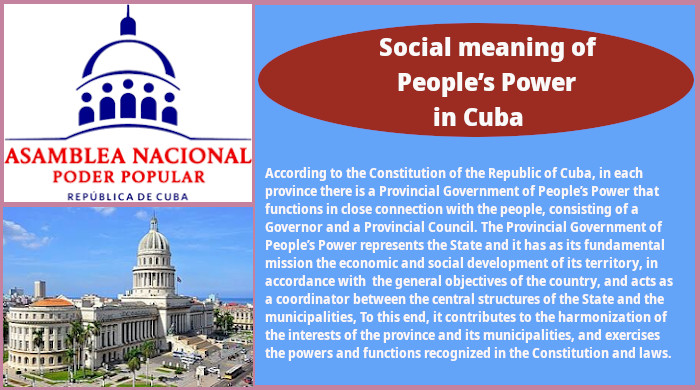
The social meaning of People’s Power in Cuba since 1979 rests on a shift from a revolutionary struggle to a structured project of daily governance that seeks to translate political ideals into everyday life. On the surface, People’s Power denotes a system in which ordinary citizens have a direct say, through neighborhood assemblies and local councils, in decisions that affect their communities. Yet the deeper meaning lies in how this framework reshaped social expectations, citizen responsibilities, and the balance between collective goals and individual aspirations.
The 1979 constitutional reform formalized a more centralized yet participatory model. The new structure codified a vision in which the state plays a guiding role in education, health, housing, and employment. This arrangement reinforced a shared ethic: everyone contributes to the common good, and the state, in return, guarantees essential social services. It offers a sense of security and belonging for many who benefited from universal healthcare, subsidized housing, and free education.
People’s Power gave ordinary citizens a tangible route to influence local decisions. Delegates elected at the neighborhood level are tasked with representing residents’ concerns to municipal and provincial authorities. In theory, this fosters accountability and responsiveness. In practice, the impact varies by locality. In some communities, assemblies became forums for practical problem-solving, garbage collection schedules, street repairs, or the distribution of resources to vulnerable families.
The model shapes social identity and daily routines. The idea that power is exercised at the neighborhood level encourages a cooperative mindset. Residents greet one another, organize volunteer groups, and engage in communal decisions about local spaces. Schools and workplaces often reflect a culture of collective responsibility, where collaboration and mutual aid supplement formal rights.
Moreover, the system’s emphasis on education, culture, and social welfare contributes to a distinct social contract. Health care, literacy campaigns, and cultural programs are presented not merely as services but as instruments of national identity. Citizens are educated to view social progress as a collective pursuit, with the state as the steward of progress. This fosters a sense of pride and continuity, linking present conditions to revolutionary ideals.
Economic changes since 1979 also shape social meaning. The Special Period in the 1990s, though not part of the 1979 framework, tested the system’s resilience and reinforced the idea that social welfare must be protected even as resources dwindle. The response, community mutual aid, informal markets, and coworking networks, highlighted a community-driven aspect of People’s Power, where social bonds and local mutual support became vital for survival. In this light, People’s Power is not just a social mechanism but a cultural habit: planning, sharing, and mutual responsibility become everyday practices that sustain social cohesion when state resources falter.
International context matters as well.
The Cuban model presents a coherent speech of sovereignty and social welfare in a world of competing models. People’s Power is a proof that a small nation can pursue equality and autonomy without surrendering social protections. This branding reinforces national pride and unity, while also inviting comparison with other social orders. For many Cubans, the social meaning of this system lies in a narrative of endurance, collective effort, and a long-standing commitment to social fairness.
Since 1979, the social meaning of People’s Power in Cuba has revolved around a social contract that blends collective governance with universal welfare. It promises security, belonging, and a sense of shared purpose, while shaping everyday life through neighborhood participation, education, and cultural work. The governing system in Cuba provides the opportunity to every elector to take part in the election process from the very root of the National Election System.