This sentiment, echoed in the corridors of the Federation of Cuban Women (FMC) in the late 1990s, summarizes the seismic shift in Cuba’s approach to rural development following the 1995 UN Fourth World Conference on Women in Beijing. While the World Day of Rural Women is celebrated globally every October 15th, in Cuba, it evolved from a simple day of recognition into a strategic engine for socio-economic restructuring.
To understand how Cuba celebrates this day today, one must look at the “Beijing Effect.” The 1995 Beijing Conference was a watershed moment. It shifted the global conversation from “women’s rights are human rights” (a moral claim) to “gender mainstreaming” (a policy requirement). For Cuba, a nation where rural women had already been mobilized through the Revolution’s literacy and health campaigns, the Beijing mandate provided a new framework: the need to transition from “social” participation to “economic* empowerment.
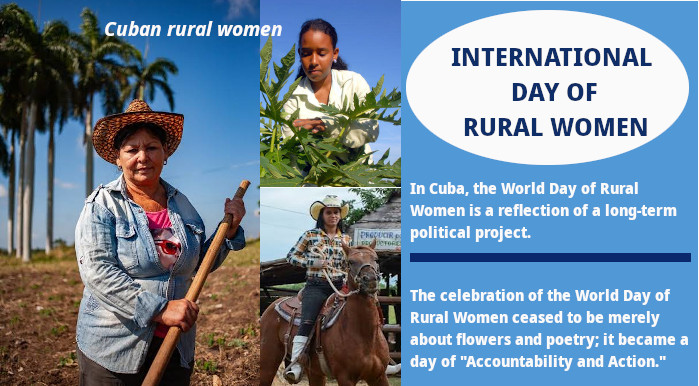
Following the conference, Cuba began to integrate the specific needs of the “campesina” (rural woman) into its national development plans. The celebration of the World Day of Rural Women ceased to be merely about flowers and poetry; it became a day of “Accountability and Action.”
Today, the celebration of the World Day of Rural Women in Cuba is characterized by, unlike traditional holidays, October 15th in rural Cuba often takes the form of a “Foro”. These are not top-down lectures, but peer-to-peer workshops. Women from different cooperatives (Cooperativas) meet to discuss crop rotation, sustainable irrigation, and the management of “Células de Producción” (Production Cells). The celebration is essentially a professional development day, focusing on the technical mastery of agriculture.
A core tenet of the post-Beijing era was the recognition of unpaid domestic work as an economic contribution. During these celebrations, Cuban municipalities often highlight the “Multitasking Woman.” Awards are not given simply for “hard work,” but for innovation—such as a woman developing a new organic pest control method or streamlining the distribution of produce to urban markets.
Because the celebration is organized largely by the FMC, the day serves as a “health fair.” Mobile clinics often visit rural communities during the celebrations, providing screenings and maternal care. This reflects the holistic approach born out of the Beijing platform: a woman cannot be economically empowered if she does not have biological and physical security.
Perhaps the most significant shift since 1995 is the move toward autonomy. In recent years, the celebrations have emphasized the role of women in the informal economy and the new “PYMES” (small and medium enterprises).
The festivities now often include “Agricultural Markets,” where rural women showcase value-added products, such as artisanal jams or processed honey, rather than just raw materials. This marks the transition from being a laborer on a state farm to being a manager of a rural enterprise.
In Cuba, the World Day of Rural Women is a reflection of a long-term political project. By taking the global mandates of the 1995 Beijing Conference and weaving them into the local fabric of the “campo”, Cuba has turned a calendar date into a catalyst for gender equity. The celebration is not a pause from work, but a celebration of the “evolution” of that work.