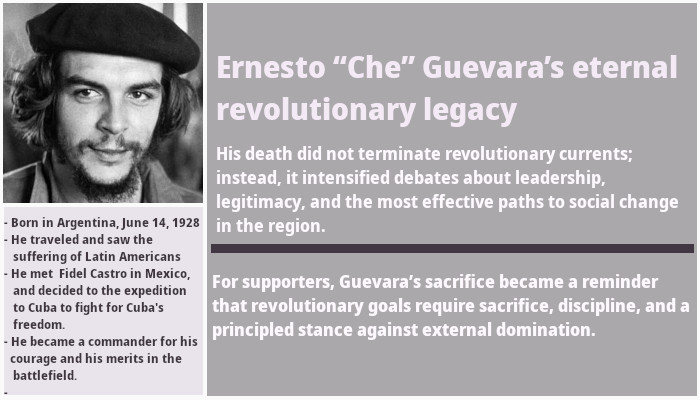
Ernesto “Che” Guevara’s death in 1967 marked a watershed moment for insurgent movements across Latin America, reshaping strategies, morale, and international perception in ways that echoed far beyond the immediate losses on the Cuban battlefield. His death did not terminate revolutionary currents; instead, it intensified debates about leadership, legitimacy, and the most effective paths to social change in the region.
First, Che’s demise deprived several movements of a powerful symbolic totem. Guevara was more than a guerrilla commander; he embodied a global ideal of self-sufficient, morally grounded resistance against oppression. For many insurgents, his image, stoic, ascetic, relentlessly committed, offered a unifying reference point. In countries like Bolivia, Guatemala’s lessons, and Colombian insurgencies, his martyrdom reinforced a narrative that sacrifice could catalyze broader struggles.
Yet the same symbolism also created pressure to emulate a particular romanticized archetype, sometimes at the expense of practical, context-specific strategy. In short, Che’s death amplified the aura of revolutionary sacrifice, while challenging groups to translate that aura into sustainable organizing and local legitimacy. Ché Guevara’s death influenced the international dimension of Latin American insurgencies. As Cold War dynamics continued to frame regional conflicts, Che’s figure served as an emblem for anti-imperialist solidarity, attracting some support from sympathetic leftist movements and students abroad. Yet state actors used his fate to justify repression and counterinsurgency campaigns, arguing that guerrilla violence was a global threat to stability.
This dual dynamic pushed insurgent groups to seek external legitimacy while negotiating with or resisting state efforts to delegitimize their causes. The result was a more complex transnational landscape where solidarity networks existed alongside intensified state surveillance and counterinsurgency efforts. The philosophical and strategic debates within movements intensified after Guevara’s death. Che’s writings, especially on the necessity of internationalist solidarity, guerrilla strategy, and the moral clarity of revolutionary objectives, continued to influence discussions.
Che’s death helped to create enduring myths about insurgency, both inspiring and cautionary. For supporters, Guevara’s sacrifice became a reminder that revolutionary goals require sacrifice, discipline, and a principled stance against external domination. The discourse around his memory influenced how movements framed their aims, communicated with the public, and navigated the balance between idealism and pragmatism.
Ernesto Che Guevara’s death did not extinguish insurgent momentum in Latin America. It altered its texture: elevating the power of symbols while exposing the fragility of strategies tethered to a single model of guerrilla warfare. Movements across the region learned to blend ideological motivation with practical organization, to seek legitimacy among local populations, and to navigate the shifting currents of global politics. The legacy of his death, then, lies, mainly in the reshaping of how resistance could be imagined, sustained, and articulated in the pursuit of social change.