
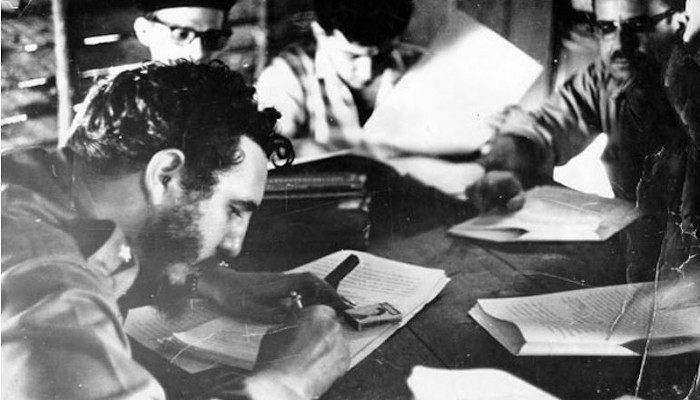
On May 17, 1959, at the historic La Plata headquarters, the rebel stronghold in the Sierra Maestra Mountains, General Fidel Castro Ruz signed an agrarian reform law that gave the revolution an agrarian, anti-imperialist, people-democratic character.
“Indeed, the promulgation or promulgation of the Agrarian Law will be one of the most transcendent events in the life of Cuba,” Fidel said that day, with great excitement, from his favorite place of struggle, where many memories were gathered and where many comrades walked the path to victory. And I added: “We understand that this law opens a whole new phase in our economic life and that our country has a great future if we all commit to working with the utmost enthusiasm.”
In his speech, he presented statistics showing the current situation, for example, 1.5% of owners own more than 46% of the country’s territory in their farms, while 111,000 farms consisting of less than two cabareras occupy less than 12% of the country’s territory. Although he recognized that this decision would hurt the interests of landowners, he considered it to be “a fair measure that would bring particular benefits to our country.”
This law sets a limit of 30 cabaret owners per owner, which would end monopolies and expropriate foreign companies, primarily American companies, thus calling into question the interests of the North American government. Remember that North American corporations owned large tracts of land, including sugar plantations, including the United Fruit Company, which owned 10,000 farms.
The revolutionary government adopted this measure only five months after the victory, for the benefit of more than 100,000 peasant families. In his defense at the Moncada barracks trial on July 26, 1953, Fidel explained that the agrarian issue was one of the issues to be resolved after the victory of the popular uprising.
The harsh reality facing farmers is disconcerting. “(…) Rural workers who live in miserable huts, work four months a year, and some die of hunger, share their suffering with their children. If they did not have an inch of land to plant and had so many hearts of stone, their presence would evoke more sympathy (…). This is what the Cuban leader explained in La Historia me Absolverá. This law, supported by articles 15, 67, seven transitional provisions, and one final provision, had a social obligation to lift the majority of the country’s rural population out of poverty.
It aimed, among other things, at the growth and diversification of industry, more efficient use of natural and human resources, and the elimination of agricultural dependence on monocultures. Its purpose was to promote economic development, encourage the emergence and development of new crops that supply raw materials for domestic industry and satisfy food consumption, as well as strengthen production lines that become a source of foreign exchange for the necessary imports for export purposes.
The aforementioned law provides for the creation of the National Institute for Agrarian Reform (INRA), which will be responsible for the implementation of the agreed agreements. The enormity of this moment was confirmed by Fidel, who celebrated the 25th anniversary of the agrarian reform law in 1984 when he stated:
“It was not only the distribution of land to the peasants who worked there, nor was it only the emancipation of agricultural workers. But in many key respects, May 17th could be said to be the beginning of the emancipation of peasants and agricultural workers.”
This day, which fundamentally changed the life of Cuban villages, was declared Peasant’s Day and is also a day of remembrance for Niketo Pérez García, who was killed on May 17, 1946 in El Vinculo Realengo, Guantánamo. On the same day in 1961, the American Association of Small Farmers (ANAP) was founded.