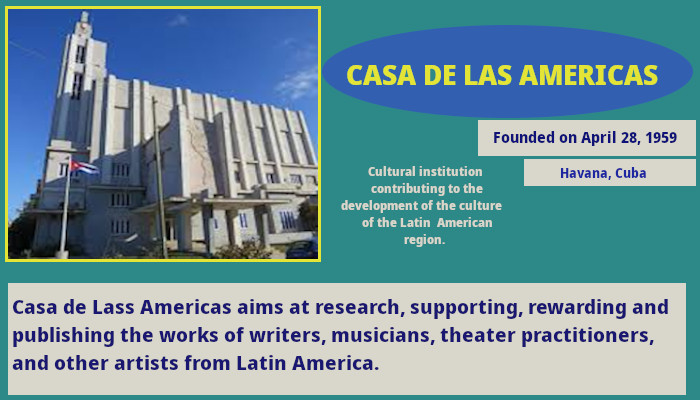
Casa de las Américas, founded in 1959 in Havana, Cuba, stands as a pivotal institution in the realm of Latin American literature and culture. It has played a crucial role in shaping literary discourse, promoting regional voices, and fostering a sense of identity and community among writers across the continent. This essay examines the multifaceted significance of Casa de las Américas, focusing on its contributions to literature, its role as a cultural hub, and its impact on the promotion of social justice and political engagement in Latin America.
From its inception, Casa de las Américas has provided a sanctuary for writers, artists, and intellectuals. The institution was created in the wake of the Cuban Revolution, at a time when many Latin American countries were grappling with political instability and cultural identity. It served as a platform that welcomed diverse literary voices, irrespective of their political ideologies and backgrounds. This inclusivity was instrumental in fostering a rich and varied literary scene, allowing for an exchange of ideas that transcended national borders.
La Casa has hosted numerous workshops, seminars, and literary contests, encouraging new and established writers to share their work and engage with one another. Notably, the foundation’s literary prizes, such as the Casa de las Américas Prize, have helped launch the careers of several prominent authors, including Gabriel García Márquez and Julio Cortázar. These awards not only recognize literary excellence but also promote the visibility of authors who speak to the diverse experiences of Latin Americans, thus enriching the region’s literary tapestry.
Beyond its literary contributions, Casa de las Américas has also been a vital arena for social discourse and political engagement. The institution has championed causes such as anti-imperialism, social justice, and human rights. Its commitment to these ideals is reflected in its support for literature that challenges the status quo and addresses issues of oppression and inequality. This engagement with political themes allows writers to use their art as a means of resistance, encouraging them to reflect on their societies and advocate for change.
In the context of the Cold War, Casa de las Américas became a meeting point for writers and activists who opposed U.S. imperialism and sought to redefine Latin American identity apart from Western influences. By providing a space for critical thought and creative expression, it has inspired generations of writers to engage with their cultural and political realities actively.
Casa de las Américas promotes not only Cuban literature but also fosters dialogue among Latin American and Caribbean writers. This regional outlook is significant, as it helps to cultivate a sense of shared identity among diverse nations. Casa has established itself as a key player in international literary festivals and has facilitated exchanges between Latin American authors and their counterparts from Europe, Africa, and Asia, thus broadening the reach of Latin American literature.
Moreover, Casa’s involvement in the publication of works in various genres, including poetry, essays, and novels, has contributed to elevating lesser-known voices on the international stage. By championing works that might otherwise be overlooked, Casa plays an essential role in diversifying the global literary canon and ensuring representation for marginalized communities.
Casa de las Américas has left an indelible mark on Latin American literature by serving as a cultural hub that nourishes creativity, promotes social justice, and fosters a sense of regional identity. Its influence resonates far beyond the borders of Cuba, positioning it as a central institution in the development of modern Latin American literary movements. In an era where literature serves as a critical tool for social change, Casa remains a beacon of hope and a vital platform for new voices, continuing to inspire the next generation of writers and thinkers across the continent.