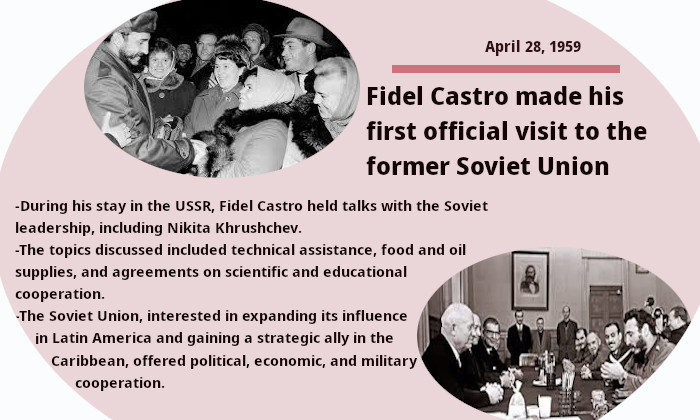
In 1963, Fidel Castro made his first official visit to the Soviet Union, an event of great political and symbolic significance in the context of the Cold War and the consolidation of the Cuban Revolution. The visit, which unfolded amidst international anticipation, marked a turning point in relations between Havana and Moscow, strengthening alliances, negotiating economic and military support, and reaffirming the internationalist dimension of the Cuban Revolution.
The roots of the trip lie in the complex relationship between Cuba and the United States after 1959. As the new Cuban government implemented agrarian reforms, nationalizations, and an independent foreign policy, tensions with Washington grew. The failed Bay of Pigs invasion (1961), the economic embargo, and increasing hostility led Cuba to seek international support. The Soviet Union, interested in expanding its influence in Latin America and gaining a strategic ally in the Caribbean, offered political, economic, and military cooperation. Within this context, the 1963 visit was a public gesture of rapprochement and mutual commitment.
During his stay in the USSR, Fidel Castro held talks with the Soviet leadership, including Nikita Khrushchev. The topics discussed included technical assistance, food and oil supplies, and agreements on scientific and educational cooperation. The relationship resulted in agreements aimed at alleviating the immediate needs of the island, affected by the blockade, and in long-term commitments to industrialization and the training of Cuban technical personnel. The exchange included the arrival of Soviet experts in Cuba and the sending of Cuban students to Soviet institutions, fostering cultural and professional ties that lasted for decades.
The visit also carried a strong symbolic weight. For the Cuban leadership, the trip to Moscow represented the consolidation of an alternative path to close dependence on the United States; it was a demonstration of sovereignty and of Cuba’s capacity to align itself with the socialist bloc in defense of its interests. For the Soviet Union, welcoming Castro meant opening a strategic front in the Western Hemisphere, capable of projecting its ideology and guaranteeing a geopolitical presence in the Caribbean.
However, the relationship was not one of mere subordination. Despite cooperation, Cuba maintained a degree of autonomy in its foreign policy, projecting itself as a revolutionary actor seeking to transform not only its own society but also to support liberation movements in Latin America and Africa. This tension between material dependence and strategic autonomy manifested itself in later episodes of the Soviet-Cuban relationship, where tactical differences and political priorities emerged over time.
The 1963 visit also influenced the international perception of the Cuban Revolution. Third World countries and anti-colonial movements viewed alignment with the USSR as a viable option for confronting Western hegemony. At the same time, the proximity to Moscow reinforced the United States’ position, which interpreted the Soviet presence in Cuba as a direct threat—a perception that had reached its peak during the Cuban Missile Crisis of 1962, a year earlier.
In the economic sphere, the resulting agreements facilitated Cuba’s access to basic supplies and Soviet industrial technology, allowing it to sustain its economy in the face of the embargo and modernize sectors such as sugar and light industry. On the military front, cooperation led to deliveries of defensive equipment and advisory services, elements that redefined Cuba’s strategic capabilities in a region militarily dominated by Washington.
In the long term, the visit helped consolidate a period of close ties between Havana and Moscow that would last until the collapse of the Soviet Union in 1991. This alliance left a profound mark on the Cuban economy, culture, and politics: joint ventures, scientific cooperation, infrastructure, and the training of entire generations of professionals educated in the USSR. It also shaped Cuba’s international strategy, which for decades acted as a promoter of revolutionary causes and a provider of medical and technical aid to other countries.
In short, Fidel Castro’s first official visit to the USSR in 1963 was a landmark event that consolidated the alliance between Cuba and the Soviet Union, offering material and political support to the Cuban Revolution and placing the island at the center of the geopolitical disputes of the Cold War. Beyond the immediate impact of the agreements, the trip symbolized the choice of a development model and international alignment that would define Cuba’s trajectory for decades to come.