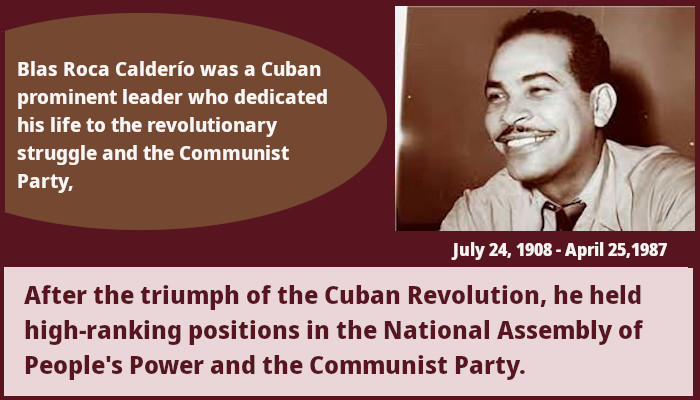
On April 25, 1987, the world marked the passing of Rubén Calderío, a figure whose legacy is deeply intertwined with the political and social upheavals that shaped Cuba in the twentieth century. Known widely by his nom de guerre, Blas Roca, Calderío was more than a mere participant in history; he was a pivotal architect of the Cuban revolutionary movement and a steadfast leader whose influence extended beyond his lifetime.
Born into humble beginnings, Calderío’s early life was marked by the harsh realities faced by many working-class Cubans. These formative experiences galvanized his commitment to social justice and propelled him into the labor movement, where he quickly distinguished himself as an articulate and passionate advocate for workers’ rights. His leadership qualities soon garnered attention, leading him to ascend the ranks of the burgeoning Communist Party of Cuba during a period rife with political tension and social inequality.
Blas Roca’s tenure as secretary general of the Communist Party before the triumph of the Cuban Revolution was characterized by strategic acumen and unwavering dedication. During these years, he navigated a complex political landscape, balancing ideological purity with pragmatic alliances. His ability to unify disparate factions under a common cause was instrumental in consolidating the party’s influence and laying the groundwork for the revolutionary victory that would come in 1959.
Beyond his political achievements, Calderío was also an intellectual force. He contributed extensively to the theoretical foundations of Cuban socialism, advocating for a model that prioritized both national sovereignty and international solidarity. His writings and speeches emphasized the importance of worker empowerment and the role of the Communist Party as a vanguard in the struggle against imperialism and capitalism.
The death of Blas Roca on that April day in 1987 marked the end of an era. Yet, his legacy endures through the enduring institutions he helped establish and the generations of activists and leaders he inspired. His life story serves as a testament to the impact that committed and visionary leadership can have in shaping the destiny of a nation.
In reflecting on Rubén Calderío’s contributions, it becomes clear that his role transcended the conventional boundaries of political leadership. He embodied the spirit of resistance and hope for a marginalized people, channeling their aspirations into a movement that reshaped Cuban society. As history continues to evaluate the complexities of Cuba’s revolutionary journey, Blas Roca remains a symbol of unwavering dedication to social justice and political transformation.