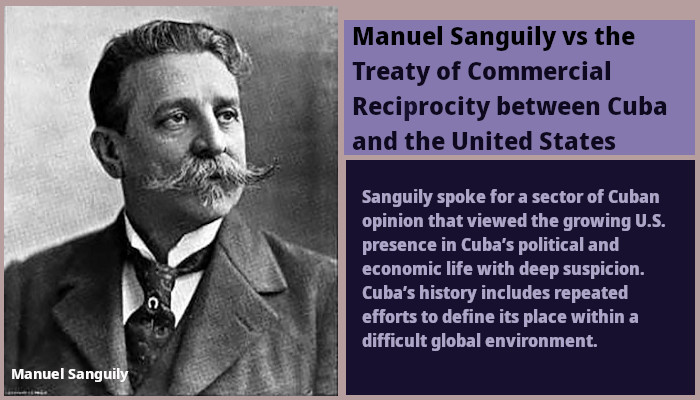
Manuel Sanguily’s opposition to the 1903 Treaty of Commercial Reciprocity between Cuba and the United States highlights how complex and contested the relationship between the two countries became in the immediate aftermath of Cuba’s war of independence.
As a former colonel in the Ejército Libertador (Liberation Army) and a public figure shaped by the independence struggle, Sanguily spoke for a sector of Cuban opinion that viewed the growing U.S. presence in Cuba’s political and economic life with deep suspicion. In his view, the treaty was not simply a technical trade arrangement; it signaled an uneven partnership that could limit Cuba’s ability to set its own priorities.
His rejection of the agreement underscored concerns about national sovereignty—the right of a country to govern itself and make binding decisions without outside control. Sanguily feared that preferential trade terms would tie Cuba’s economy too tightly to U.S. markets and policy preferences, creating dependency and giving U.S. interests disproportionate influence over Cuban development. From that perspective, the treaty risked narrowing Cuba’s options for building a diversified economy and protecting emerging national industries.
This episode matters because it helped launch a broader, long-running debate about Cuban national identity and the country’s future in an international system dominated by powerful states. Sanguily’s stance also reveals internal tensions between the pursuit of autonomy—Cuba’s desire for genuine independence—and the external pressures, especially from the United States, that shaped early republican life.
Sanguily’s opposition resonated with various sectors of Cuban society, especially among those who had fought for independence and feared that the treaty would consolidate U.S. control over the Cuban economy. However, despite these objections, the Reciprocal Trade Treaty was finally ratified in 1903, leading to increased trade between the two countries.
In the long run, the decisions made during this period would lay the groundwork for future tensions in the relationship between Cuba and the United States. The perception that the country was being used as a market for U.S. goods would fuel popular discontent and contribute to political and social movements seeking to break free from this dependence.
Questions of sovereignty and autonomy remain relevant today, and Sanguily’s struggle serves as a reminder that Cuba’s history includes repeated efforts to define its place within a difficult global environment. As well as that the will and spirit to fight for independence and sovereignty firs, and later to keep them were and still are the leading strength of the Cuban people through their history.