
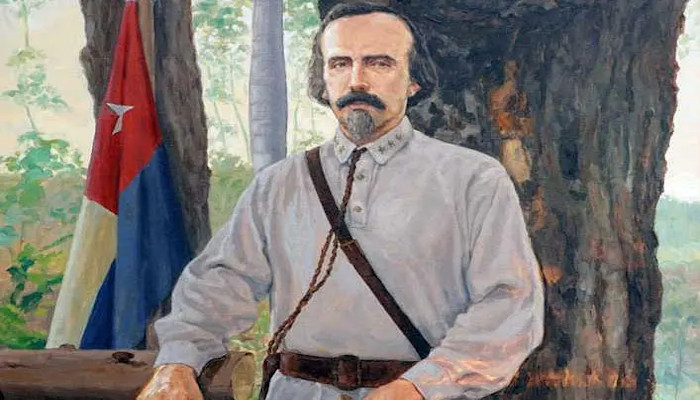
The rain in Bijagual did not wash away the bitterness; it only turned the camp into a slurry of mud and melancholy. It was October 1873, and the humidity clung to the men of the Cuban Liberation Army like a second, heavier uniform.
Inside the rough-hewn timber hut that served as the headquarters of the Republic in Arms, Carlos Manuel de Céspedes sat by a dying lantern. He was not writing a proclamation, nor a letter to a foreign diplomat. He was staring at the flame, listening to the drumming of the rain, waiting for the inevitable.
There was a rustle at the door. The guard stepped aside, and a delegation of officers stepped in, shaking the water from their sombreros. Their boots squelched against the wooden floorboards. Leading them was a man whose face was a mask of conflicting loyalties: Major General Ignacio Agramonte.
But Agramonte was not the one who spoke. He stood slightly back, his arms crossed, his eyes dark. It was a representative of the Chamber of Representatives who held the folded paper.
“Mr. President,” the representative began, his voice lacking the usual boom of military command. “The House has voted.”
Céspedes did not stand. He looked up, his white beard framing a face that had aged ten years in the five since the uprising began. “I know what they have voted, Francisco. The rain carries news faster than a horse.”
“It is the deposition of the Presidency,” the man said, stepping forward to place the document on the rough table. “Citing the powers granted by the Constitution of Guáimaro, the Chamber relieves you of your duties as President of the Republic.”
Céspedes finally stood. He was a tall man, broad-shouldered, even with the stoop of exhaustion. He picked up the paper, not reading it, but feeling its weight.
“Am I to be arrested?” Céspedes asked calmly.
“No, sir,” Agramonte spoke up, stepping out of the shadows. “You are stripped of office, not your honor. You are free to go to San Lorenzo, or wherever you wish, to continue the fight as a soldier.”
Céspedes let out a short, dry chuckle. “A soldier. Five years ago, I freed my slaves and rang the bell of La Demajagua. I was the Father of the Nation. Today, I am merely a soldier.”
“The war cannot sustain a dictatorship, Carlos,” Agramonte said softly, dropping the formalities. “The Chamber feels you have overstepped. The suspension of civil liberties, the imprisonment of representatives… we are fighting for a Republic of laws, not for one man’s will.”
“I overstepped to save this army from its own tail!” Céspedes’s voice rose, the first crack in his dignity showing. “While you gentlemen debate procedure in the safety of the Chamber, the Spanish walk through the burning cane fields. I centralized power to move, to strike, to survive. Law is a luxury when you are bleeding.”
“And yet,” the representative interjected, “without law, we are no better than the bandits the Spanish claim us to be. The vote was twenty-four to six. It is done.”
Silence filled the hut, heavier than the humidity. Céspedes looked at the men he had led. They looked away, ashamed.
He realized then that he had been fighting two wars: one against Spain across the island, and one against the pettiness of the revolutionaries beside him. He had won many battles against the former, but he had just lost the latter.
Céspedes reached for his lapel and unclipped the golden star that signified his rank. He placed it gently on top of the deposition paper.
“Very well,” he said, his voice returning to its steady, baritone calm. “The Constitution is the soul of our cause. If I am the body that hinders it, then I must be cut away. I do not do this for you gentlemen. I do it for Cuba. I will not be the cause of a civil war within a civil war.”
He walked to the corner of the room and began to gather his few personal belongings—a change of shirt, a leather bound volume of poetry, a portrait of his late wife.
“General Agramonte,” Céspedes said, shouldering his bag.
“Sir?”
“Take care of the Eastern District. The Spanish are massing near Santiago. Do not let politics cloud the aim of your machete.”
“I will, Carlos.”
Céspedes walked to the door. He paused, looking out into the gray deluge. The wind howled through the palm trees.
“Ten years from now,” Céspedes said, speaking to no one in particular, “history will ask what we did here. Tell them I did not resist. Tell them I loved the law more than my own power.”
He stepped out into the rain. The mud sucked at his boots as he walked toward his horse. A young soldier, barely eighteen, stood holding the reins. The boy looked confused, seeing the President without his guard, without his star.
“Where are we going, Mi General?” the boy asked.
Céspedes mounted the horse. The rain plastered his hair to his forehead. He looked back at the hut one last time, the light of the lantern flickering like a dying heartbeat.
“To San Lorenzo, my boy,” Céspedes replied, turning the horse toward the dark mountains. “To write poems, and to wait for the Spaniards to find me. The Presidency is over. The duty remains.”
He spurred the horse. The sound of hooves splashing through the mud was swallowed by the storm, leaving the revolution behind to continue without its founder.