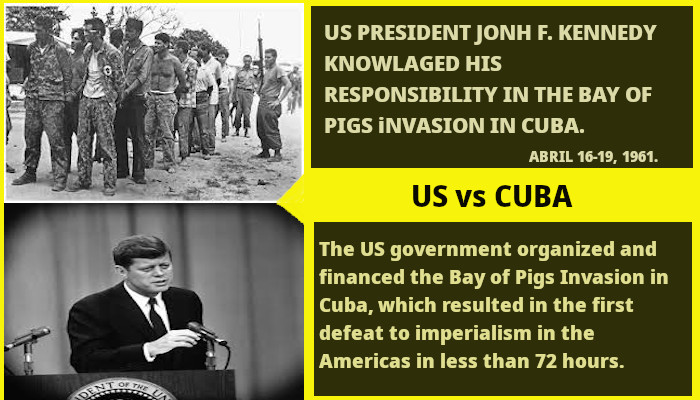
The initial months of John F. Kennedy’s presidency were marked by a singular, disastrous incident that would influence the course of the Cold War and American foreign policy for the next ten years. In April 1961, a paramilitary group of Cuban exiles, trained by the CIA, landed at the Bay of Pigs (Playa Girón) with the goal of toppling Fidel Castro’s revolutionary government.
The operation culminated in complete failure within three days. While the military defeat was deeply embarrassing, the most significant moment occurred days later when President Kennedy spoke to the American public. In an unprecedented move in modern American politics, Kennedy acknowledged the U.S. government’s role in the aggression. This admission, which confirmed the Cuban view of the invasion as a “mercenary aggression,” represented a crucial turning point in presidential accountability, U.S.-Cuban relations, and the overarching geopolitical strategy of the Cold War.
To grasp the significance of Kennedy’s acknowledgment, it is essential to first comprehend the nature of the operation itself. The invasion was not a spontaneous uprising but a carefully orchestrated foreign intervention. Developed under the Eisenhower administration and passed on to Kennedy, the plan involved Brigade 2506—a contingent of Cuban exiles funded, equipped, and trained by the United States. From Havana’s perspective, this was not a liberation effort but an act of imperialism; the invaders were perceived as “mercenaries” serving a foreign power.
As the landing faltered due to insufficient air support and a lack of local popular backing, the narrative transitioned from one of imminent regime change to one of captured soldiers and international disgrace. In the immediate aftermath, President Kennedy confronted a challenging decision. The prevailing political wisdom of the era advocated for denying involvement or attributing blame to the previous administration or rogue elements within the intelligence community.
On April 21, 1961, Kennedy addressed the nation through television, accepting full accountability for the situation. He famously remarked to the press, “There’s an old saying that victory has a hundred fathers and defeat is an orphan.” He clearly stated that the failure of the operation was “mine, and mine alone.”
By taking responsibility, Kennedy implicitly recognized the legitimacy of the Cuban accusation. He confirmed that the United States had indeed acted aggressively against a sovereign nation by employing a proxy force. This acknowledgment had significant domestic repercussions. Ironically, it enhanced Kennedy’s public approval rating; the American populace admired the honesty and courage it took to admit to such a substantial error. It set a precedent for presidential accountability that, although not consistently adhered to in the future, established a high standard for leadership during crises.
Nevertheless, the geopolitical ramifications of this “mercenary aggression” and its subsequent acknowledgment were severe. In Cuba, the failed invasion and the affirmation of U.S. involvement became a rallying point. It reinforced Fidel Castro’s authority, quelling internal opposition and legitimizing the Cuban revolution’s alignment with the Soviet Union. Kennedy’s admission confirmed the Cuban leadership’s deepest fears: that the United States would go to any lengths to undermine the revolution. This sense of paranoia and defensiveness directly contributed to the conditions leading to the Cuban Missile Crisis in October 1962, as Castro sought a nuclear shield to guard against further aggression.
Moreover, the admission prompted a reckoning within the U.S. government. Kennedy, embarrassed by the intelligence shortcomings and the military counsel he had received, sought to exert greater authority over the extensive national security framework. This resulted in a restructuring within the CIA and a more cautious, skeptical stance towards military recommendations from the Joint Chiefs of Staff. The president who had sanctioned the invasion emerged from this experience with a heightened resolve to comprehend the intricacies of global diplomacy, a transformation that arguably shaped his subsequent dealings with the Soviet Union.
In hindsight, the statement “President Kennedy acknowledges the responsibility of the U.S. government in the mercenary aggression against Cuba” acts as a historical pivot. It distinguishes the period of covert, plausible-deniable operations from an era characterized by more direct confrontation and superpower rivalry. The phrase “mercenary aggression” removes the romanticized facade of the “freedom fighter” narrative that the U.S. had sought to project, revealing the stark reality of Cold War proxy warfare.
Kennedy’s admission serves as a case study in the complexities of political leadership. It represented a moment of personal integrity that restored his domestic reputation but also intensified the militarization of the Cold War and solidified the animosity between the United States and Cuba. By acknowledging the failure of the Bay of Pigs, Kennedy bore the weight of the “mercenary aggression,” a historical burden that continues to affect the relationship between the two nations to this day.